Oak Tree Help
If you want to learn more oak trees you can check out our oak tree page.
If you want to learn more about planting under an
oak tree you can check out the planting under
oak trees page.
To Keep Your Mature Oaks Healthy and Happy
or Help a Stressed, Unhealthy Oak Back to Health:
Check for these:
Summer water
Assess the area; find out if the oak is receiving summer water. If a mature oak is, receiving summer irrigation, gradually decrease the summer water until there is no summer water. Lawns and drip irrigation are a big NO NO!
Weeds
Find out what is growing under the oak; there may be a mixture of native and non-native, or alien, plants. You want to remove the alien plants and keep the native plants. See weeds.
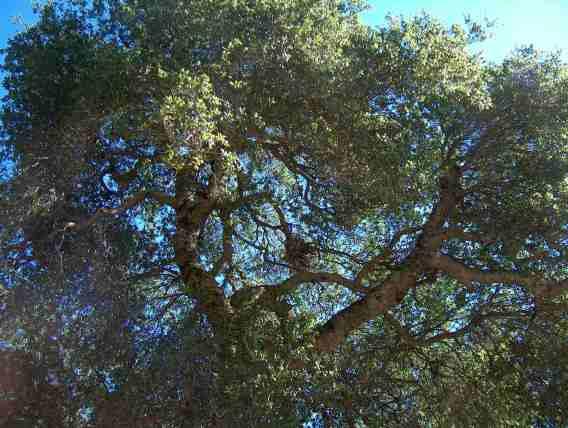
Oaks will commonly do fine with a conventional lawn or garden under them for about 10 years, then they get buggy and start to die. Their immune system and root structure is compromised. Sometimes you can get them back to degree of health, sometimes not. After a lawn or English garden, they are like an aids patient.
Plant community
Plant associated shrubs that usually live alongside or under oaks. Check individual listings under specific oaks. To learn more see the Plant community pages.
Mulch
Let the natural oak mulch build up under the tree, by removing the weeds.
Amendments
Do not amend the soil near oak trees

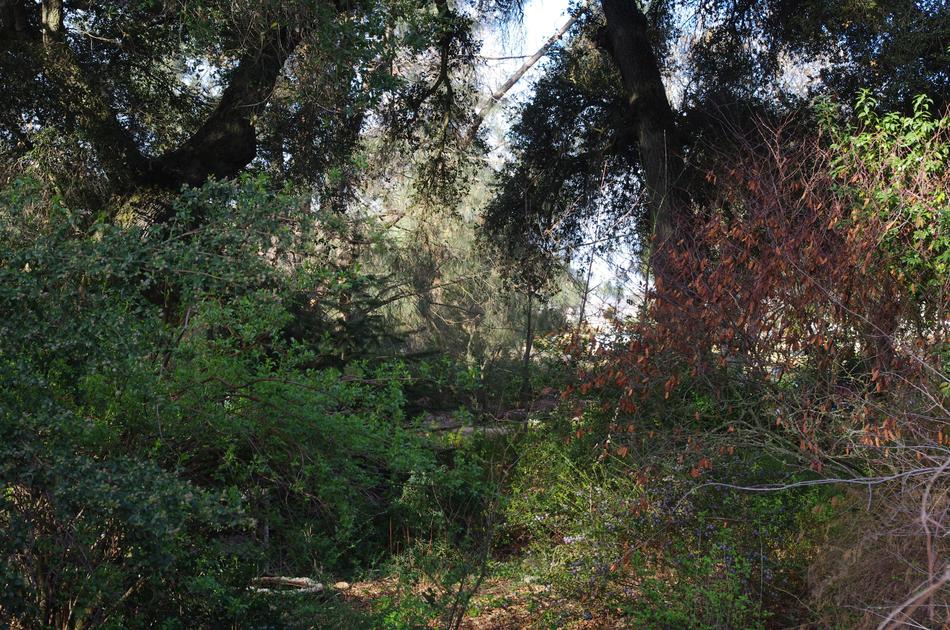
DO NOT FERTILIZE oak trees (under any circumstances)!
Fungicides and insecticides
Do not spray fungicides or insecticides on oak trees. There are a lot of good fungi on the oak that the Oak requires to survives. Many insects play an important role in the ecology of the oak tree. 'Bad insect” population explosions are usually a sign of bad ecology. In most cases you are only removing the symptom by spraying the insects!
Pruning
Do not prune mature oak trees. (light pruning is OK so that you can walk under the oak or so the limb is in not in danger of falling on your house, car or person.) Remember, many birds nest in cavities in the dead branches.
To reiterate mulch:
1. Healthy oak leaf litter (without weeds) supports microorganisms that provide protection to oaks from disease.
2. Healthy oak leaf litter supports microorganisms that provide critical nutrients to oak trees.
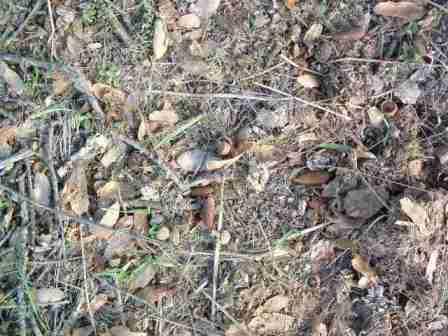
3. Healthy oak leaf litter supports microorganisms that provide water to oak trees.
4. Oak trees will have a much shorter, sicker life span without healthy oak leaf litter.
5. Oak trees do not grow well by themselves; they grow better with their associated plants. For most of you, you can plant native cover to help along your young oak trees. In the coast ranges this is commonly Bush Baccharis, Baccharis pilularis, south of San Francisco, Black Sage, Salvia mellifera, north of San Francisco, Ceanothus species (California Lilac), and south of Santa Maria Purple Sage, Salvia leucophylla, can be used. In most of California, California Buckwheats, Eriogonum fasciculatum, are great along with whichever Sagebrush, Artemisia spp., is native in your area. Sages, Salvia spp., Buckwheats, Eriogonum spp., Monkey flowers, Mimulus or Diplacus spp., California Lilac, Ceanothus spp., Currants and gooseberries, Ribes spp. and Manzanita, Arctostaphylos spp., can commonly be used in landscaping for the same purpose; cover the ground, control all weeds, and create habitat for the wildlife, Waa La! If there are reproducing oak trees in your area you will also see baby oak trees coming up under your planted native shrubs. But you need NATIVE cover that is at least close to what it should be on your site (Chaparral plants in chaparral or coastal sage scrub along much of the coast, yellow pine forest plant if you live in the mountain forests) and you need at least a few native oaks left in the area.
You can help the birds after your yard or hillside planting establishes itself by wandering the streets gathering acorns to throw under your bushes. This achieves several objectives: you get baby oaks under your bushes, you can talk to every cop in town, (nobody knows what to do with hikers in towns anymore), your neighbors will start referring to you as the weirdo that's hanging around under the trees, you'll learn where all the oaks and dogs on the street are, and if you gather on your day off everyone will know you're unemployed, life will not be boring! AND you'll get your exercise running from the dogs!

Fog drip and weeds
On Vandenberg Air Force Base it has been documented in one stand of Tanbark Oaks, Lithocarpus densiflorus, that the rainfall is 14 inches; but the fog drip is 38 inches, and total precipitation is 52 inches. If weeds get under the oaks the fog drip is almost entirely lost (the weeds capture it for themselves), and most of the trees immune system (the roots are protected by a group of fungi called mycorrhiza) collapses and pathogens start replacing the mycorrhizal links on the roots. We used to think the trees could tolerate some weeds; we now think they can tolerate hardly any. It appears that the slower-growing oaks like Blue oaks Quercus douglasii, Quercus parvula, most of the other Scrub oaks and Quercus X alvordiana may only be able to tolerate 10% or less weed coverage under the oak from the trunk out to double the drip line in distance. At 10% weed coverage oaks slow their growth and acorn production. At about 30% weed coverage most oaks start declining. As little as 5% weed coverage may allow them to be increasingly susceptible to Sudden Oak Death.
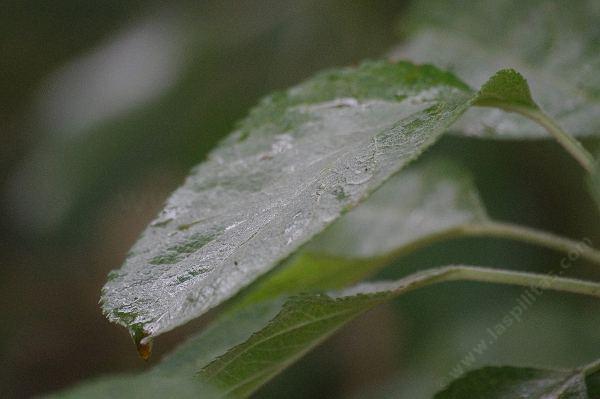
Fire Note: Oaks by themselves are relatively fire safe; add weeds under them and they become a 100 foot fireball.
Weeds kill Oaks
Usually, in the central coast ranges, there are massive amounts of alien annual grasses growing under oaks. These alien plants choke the life out of the oaks. Remove alien annual grasses from under oaks at the same time trying not to disturb the soil. Pretty hard, huh?
Herbicides
Specific herbicides that target grass work well (Don't spray the native grass.) Other sprays can be used to kill star thistle and other nasties.
Weedeating
Weedeating is like scraping the pus off of a wound, it really is not healing the wound, the weeds are still there! (It does reduce weed numbers though, if you weedeat before the weeds set seed) weedeaters aren't exactly selective either. You will have trouble weedeating the weeds and not the natives.

Pulling the weeds by hand?
This causes soil disturbance, and at the same time, encourages gophers to move into the area, eating everything that takes their fancy (this means almost any living plant!) and provides a perfect seed bed for the alien annual grasses. If you pull the weeds by hand, afterwards, place tree chippings from the local arborist or utility company, preferably mostly oak, on the soil, if there is no mulch layer. This will work as a good mulch until the tree produces enough of its own mulch, to make a nice thick, at least 2 inch layer. Or just keep pulling the weeds, trying to disturb the soil as little as possible every year until the mulch layer naturally builds up. Good luck!

Healthy Oak Leaf Litter-why is healthy oak leaf litter important to the health of the oaks?
Because the group of microorganisms that live in this area, where the oak leaves meet the soil, are responsible for, among other things, protecting oaks from diseases, (the microorganisms produce specific antibiotic and antifungal agents, produce food for the free-living microorganisms that attack disease organisms) and providing oaks with nutrition and moisture. These microorganisms extract nutrients and water from the oak leaves as they slowly break down some of the leaves, at the same time preventing the breakdown of most of the leaves, and holding them in so-called 'storage', to be broken down as needed. When the oak leaf litter layer is replaced by alien plants and their litter (dead alien plant parts on the ground) the oak tree loses a large portion of its disease protection, nutrients and water. The weeds take the water and nutrients that would otherwise be used by the oak and its associated microorganisms. There! So the tree has lost a good portion of its disease protection, food and water. Also, now that the group of microorganisms that lived in the oak leaf-bare soil interface, is weakened because their tiny habitat has turned into a mass of weeds, and they cant access the nutrients and water as before, it is not functioning well and cannot provide protection to the oak tree from disease.
The oak tree is obligately mycorrhizal. That means if the fungi ( the dominant group of microorganisms that are part of the specific group of microorganisms that live in this mini-habitat, in cooperation with the oak, are unhealthy, and they start dying, then the oak tree dies. The oak tree can not live without the fungi. That is why oak leaf litter is crucial to the health of the oak tree. There are many species of microorganisms that live just on and with one oak tree, and different species live with trees at different points in the oaks' development. To put it simply, remove the weeds, let the oak leaves fall and form a thick, soft, moist mulch and voila, the microorganisms and, in turn, the oak tree, will be healthier. Mulch cannot work alone, though. Oh, did I mention associated plants? There are many species of native plants that live under the canopy of the oak. If the plants are present, that is great. If they are not present, then that area will be very difficult to maintain free of weeds. Replace the weeds with the oak leaf litter AND the oak's associated plants.
As an analogy, weeds are like a staph infection in a human body. Your body can tolerate a small quantity of this infection and your immune system will suppress the bacteria. If the bacteria pulses your body you probably will die if not treated immediately with antibiotics. Scraping the bacteria off of your arm or leg doesn't remove it, it just makes more entry points. Weeds in a native system behave the same way. Kill the suckers with herbicides (analogously, antibiotics) if possible. Hand pulling the weeds usually makes more infection points; that is, it disturbs the soil, which makes a perfect seed bed for more weeds (remember, they thrive on disturbance) and gets the gophers all excited, and making new burrows, and eating lots of plants that you wanted to save, but it does remove the weeds. Again, try to hand pull the weeds with the least soil disturbance possible. The native oak mulch layer is VERY,VERY important. It is like the body's skin. It is very important that it remain native and undisturbed. If you're planting plants under oaks, make sure the plants are native under oaks. Non-native plants under an oak are weeds to the oak, and rob the life out of the oak and allow pathogens and herbivores to target the oak in many pathways that seem completely inconsistent, such as deer eating your oak tree, but not the oaks nearby with no weeds under them. The weeds are considered an alternate, competitive, non-cooperative ecosystem with a completely different set of pathogens, energy collection, and life strategies. Much of the native wildlife that depends upon the live oak trees usually leave before the oaks die. So, if you want healthy oaks and wildlife, kill the weeds!