Landscaping Your Home In a Fire Area
The first step in protection is observing the vegetation and terrain around you.
Could you and your house survive a fire? Would firemen have a chance to save it?
Which way does the wind blow? Are there prevailing winds? The areas directly affected by the wind should have a larger clearance. If the area has a strong afternoon wind pattern, the fire will probably follow that path, usually at a faster rate.
Look for sharp slopes below the house, these need low fuel landscaping for the distance proportional to the height and flammability of the plants on the slope. Flammable trees such as eucalyptus and pines need a 250'+ buffer if below a house. Eucalyptus look exactly like a 150 foot fireworks stand firing off.
Look at your wood pile, junk pile, storage area, hay stack, etc. and make sure it is in an open area (or inside a building) the sparks (or animals on fire) can not easily access. Try to position these with a 30'+ buffer from the house or garage.
If your house has a shake roof or wooden walls allow more clearance . (Beyond about 50 ft., it doesn't help much. Cohen, 1999.) The heat from the fire can ignite these and embers from the fire a mile away can light every shake roof in the block. In the Fallbrook fire of 2002, avocado leaves from nearby trees were picked up by the fire-generated winds and pressed against the eves of the stucco/tile roofs. The exposed rafters and curtains on the windows ignited most of the 40 houses that burned down. (Picture your house above a chimney after you stupidly put the Christmas tree in the fireplace.) By the way, If you're in one of these areas, change from fiberglass screens to metal screens, maybe covering the entire window.
The second step is to improve your horticultural practices.
An overhead watering system should be considered to provide water to all plants within a 100'-150' radius from the house and other buildings. The plants need to have moisture in them when the firestorm comes. Watering dry plants as the fire approaches does not work. Since a wildfire can happen at anytime, weeds have changed the 'normal' fire season, you'll need to water lightly every two weeks if it doesn't rain. Wash the foliage off, but don't get the ground wet. When I was a fireman I pumped water into a landscape fire before, used a 2 1/2 inch fire hose and watched the water vaporize long before it reached the plant material. When the fire comes, it's too late to water, as part of your planning, water a little every week.
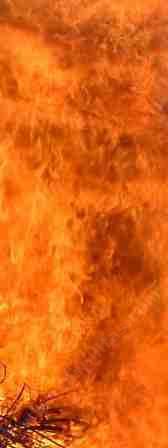
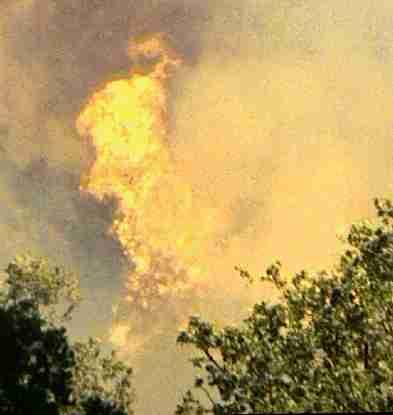
Weedy grasses, mustard, anise, broom and most other weeds can create a big problem. Even when mowed, these fast, flashy fuels can catch you or firemen unaware that the fire is even near, never mind fifteen foot flames moving at 50 miles per hour. Mix the weeds with Chamise (Adenostoma fasciculatum), Buckwheat (Eriogonum spp..), Black Sage(Salvia mellifera) and other drought adapted native plants, or non-native plants, (which are generally even drier and more flammable), and you have a bigger problem. Proper hygiene in the landscape will make you much safer. Dead grass acts as kindling, producing ten foot flames. This burning grass 'feeds' the bushes, which have 5'-30' flames, and these 'feed' your trees, which can put up a fire ball 75' tall and 50'+ wide. Weedy grass fires burn like the prairie fires in the old movies or gasoline. 20,000 acres in 20 minutes. Hard to describe unless you see it, one acre in a few seconds, 10 acres in a few more seconds, one hundred acres in 15 seconds. It looks like a gasoline fire on television, but a lot scarier.
Thinning out the flammable bushes and removing the dead grass or controlling the grass and weeds with sprays will make you more fire safe. Removing all 'brush' and replacing it with grass, is dumb. The brush trade off is higher, less flammable fuels versus lower, more flammable fuels and more erosion. Low density(the foliage has five to ten foot gaps between plants for shrubs, 50+ foot gaps on trees) are a compromise. Ice plant does not hold hillsides, its ecology is for the hillside to slip, which spreads the iceplant. (And some of the houses in Southern California burned down with 300 ft, of iceplant around it.) Grasses also also have very shallow roots and are prone to slides. Most of the native brush burns slower than the plants you replace them with. A watered apple tree leaf burns faster than an unwatered Ceanothus leaf.
Native leaf litter and thick organic mulch is ok only if it is clean, weed free, and has no big twigs (larger flame height) mixed in with it. Again, these act as kindling for the larger bushes. The mulch creeps and after a few days, can burn up your landscape. But the flame height is very low, shredded redwood or cedar bark have maybe a 1-2 inch flame height, with a 30 mile an hour wind on it. No wind, no flame. Jute matting has a foot and half flame on it if there is even a breeze or it is on a slope. If granite paths are used to break up the planting, and the house has a no burn 30 foot strip(concrete, lawn, patio, decomposed granite) around the house, generally, no problem.
All the surrounding trees should be trimmed so that a man can walk under them. All the dead limbs should be trimmed out and removed.
The next area, 30-100' (larger in high wind areas or steep slopes), should be regularly watered as in 15 minutes a week for most native installations. Basically, as a general rule, this area needs to be cleared of 50-60% of the vegetation, leaving 40-50%, with large, mulched open spaces in between, weed-free.
To make a landscaping cheaper, more fire resistant, and more attractive it is desirable to put walkways throughout this area of the plantings. The walkways should be 4-5' wide; they can be gravel, brick , or concrete. The plantings then can be decreased in size to areas of 300-1000' sq. ft. . Less water is needed, and less maintenance, while the result is firebreaks throughout the planting. Most people are very happy with this because it gives access to the landscaping and makes a low maintenance landscaping even easier. Also, boulders do not support fire well.
The third area is the 100'+ area and it needs to be cleaned up. Thin the brush and trees so that there is a 10' space between all plants 5' and over. The smaller plants can be left in clumps of 10' or less with 10-15' spaces between clumps. This gives a naturalized look to the landscape while it removes much of the potential fuel and makes what is there difficult to spread its flames. Do not forget to prune up trees and clean up the weeds. The residue after the clean-up should be 1" or less in size (no limbs). Before Europeans showed up with weeds, there were many spots of bare soil between the bushes. You could walk barefooted!
If your house is below a slope try to have 15-20' between the bottom of the slope and your home. A non-burning fence along the base of the slope is also very helpful for catching embers, flamming trees, and rabbits on fire as they roll down towards you.
Try to make decks, sheds and other flammable items tight. That is, little or no cracks or openings. During a fire winds will push embers into those cracks and animals on fire can run into the openings or under your deck. In many fire situations the fire creates its own winds. Put the deck on the ground, close up any overhangs tightly, or make the spaces very open.(This will help to remove the kindling effect of pieces of dry wood; boards spaced one foot apart are much harder to light than ones one inch apart.) Can you stuff a garbage bag of burning avocado leaves under your deck? If you can you need to make your deck a patio of rock or concrete.
If you haven't built your house,
and you're
planning on a hilltop house in fire country, look at concrete block, no
eves and a tile roof. Roll the house down the slope just a
little out of the daily breeze, your neighbors can't see you, and it's
a lot quieter. Put a patio or pool on top of the mountain.
Pre-plan what will happen in a fire situation
Plan on not having any water. The
electricity usually will go off if the fire is big. If the fire is
large everybody, everybody
will water down their roof, their weeds
,their walls etc.. Water systems are not designed to provide
water
for all at once. The people nearest the fire will have the least amount
of water pressure because they are in the center of the overdrafting.
Your hoses will make sucking noises when you turn them on.
So again, do not plan on having water when a fire comes your way. Do your watering weeks before the fire. Your plants usually will act as a fire break. You'll lose your plants but not your house as the plants will pick up the radiant heat from the fire. Ceanothus can work very well for this. Again, a watered apple tree burns better than an unwatered Ceanothus, a Ceanothus with the dust washed off occasionally is amazing.
Plan
on being on your own when the fire goes through. In extensive fires
there are not enough fire engines and firemen to help everybody at
once. You may have no notice that there is a fire until it goes past
you. That neighbor below that never weeds, likes to get drunk and
barbecue on hot windy days?
If there is poor clearance firefighters can not be expected to protect your structure when they cannot protect themselves.(Drive-by fire protection.) You want the firemen to park next to your house. A safe place to park, access to a water source, maybe a refrigerator with cool drinks and sandwiches?
When a fire rolls through there is
no time for you to do much but pack (in some cases 1 minute) and
leave. Do not expect to have time to react otherwise. Preplan your
escape and what you need to take with you. You can leave the
horses in
their corral, the safest place for them to be. Some of the folks in
Fallbrook jumped in the pool when the fire blew through. You may need
to step back into the house as the fire is already there, come back
outside and put the spot fires out after the fire passes a few seconds
later. I want you to able to do this safely. If you preplanned,
your house may be safer than the road.

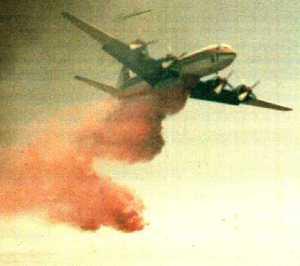

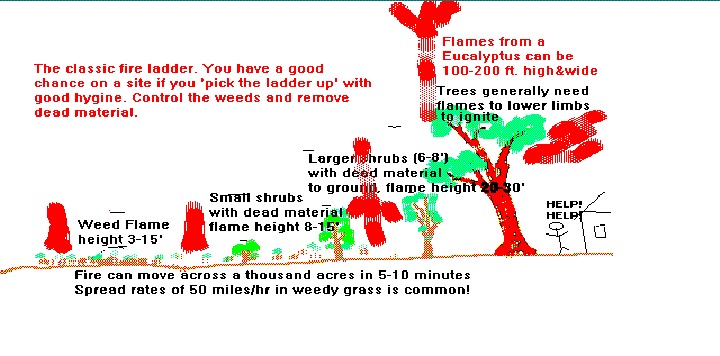

Simple wildfire prevention ideas.
Remember, a brick house with a tile roof surrounded by 300 foot of
bare ground can still burn down.
Be realistic, nothing is 100%.
Our plants even in the non-watered mode will pass this test in most spots as long as there are no weeds to light it up and the mulch is in place
Basic rules for fire safety.
Less plants. Each bush should not be
able to burn bush next to it.
A little overhead water every week or two.
Metal Screens on windows.
No flammable material next to house. Shade cloth, wood pile, furniture,
etc. Stupid things burn real well.
Good
hygiene in the yard. NO WEEDS,
no dead material.
You can find more specific fire information at these pages:
Fire garden quizWhat to do if you are in a fire area.
Planting seed or plants for erosion after a wildfire.
Smoke SignalsDeer and fire.
Post fire ecology
Post fire hillside treatment
Many years ago a reporter from one of the local TV stations interviewed me about this situation and his phrase was "IF YOU DON'T LEARN, YOU'LL BURN". This should be a slogan for fire areas.