The Wildlife Garden
Here's a checklist of things to do for attracting Wildlife!
A small garden can support a variety of wildlife, if you provide certain items.
1. A water source is important for wildlife
Water is a driving factor for many animals, especially in more arid areas of California. For large mammals a small trough is popular. We have a lot of wildlife that comes to our horse troughs bears, raccoons and deer. If you are near wild area where wildlife is present they may come to your yard just for the water. Make sure that whatever you use it stays full or else place a stick in it so that small mammals that fall in can get out again drowned rats are disgusting. Birdbaths, of course, are for the birds.
A controlled water source is important for the wildlife. How can you provide water so the desired birds and other nice critters can get it it, but the rats, raccoons and opossums have trouble getting to it?That usually means a birdbath that is at least 4 foot above the ground.

2. Cover
The Cover varies with the animal. Bushes, trees, boulders, logs, snags, form places that provide nesting sites, food, and hiding places for the birds and other small wildlife. Large rocks make nice accent points in a garden and logs can be used as boarders or benches.
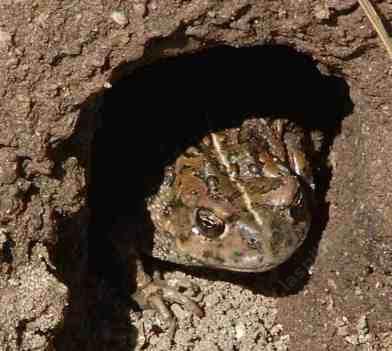
Toads may live in the same hole for 30 yrs!
3. Open ground
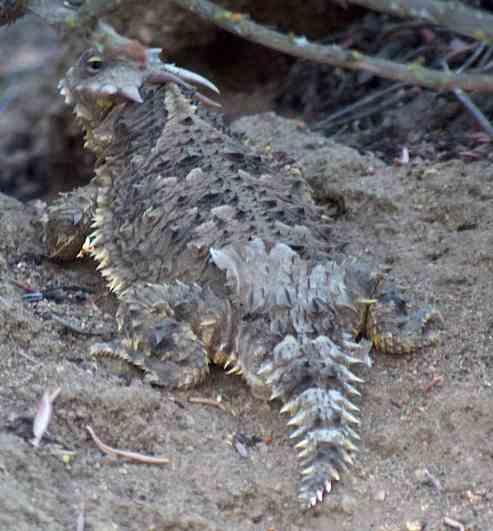
Most of the small creatures (like some butterflies, lizards, horned lizards, California Quail, Mourning Doves and others) do not like full cover. They need some areas of bare ground, in the garden, usually with decomposed granite, sand, or other semi-loose soil. This open area can be planted to annual sun-loving wildflowers for example, Poppies, Chia, and lupines, that will shrivel and disappear after flowering leaving a nice scattering of seeds in open ground for the seed-loving wildlife.
4. Mulch
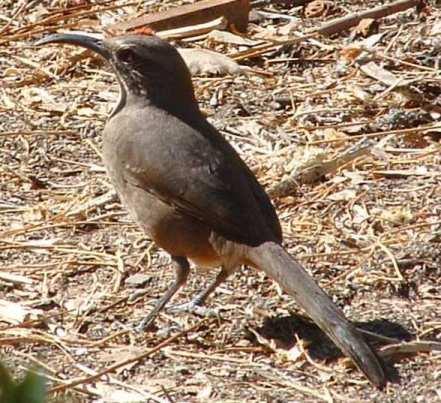
Many species of the smaller wildlife live on/in the mulch under the bushes and trees. Many birds like the California Thrasher, Hermit thrush, and the California Towhee live off the organisms in the mulch. The mulch also helps your garden! Four to six inches of oak leaves, or shredded redwood bark, holds in moisture and decomposes into great nutrients.
5. Nectar sources
Hummingbirds, Butterflies, neat wasps and bees (not those European jobs, we’re talking weird blue, and fluorescent green, purple/yellow things that look like they came from Mars) live on flower nectar. Some good flowers are Salivas spp., Ribes spp., Monardella spp., and Zauschaneria spp.
6. Fruit
No apples, oranges, and avocados here, we’re talking small bird/chipmunk bite-sized, not skunk food. The chipmunks prefer manzanita berries and Ceanothus fruits over plum pits. Mahonia nevenii is a favorite of the Western Bluebird. Elderberries are used by many birds, from the Northern Flicker to the Wrentit. Poison Oak, Poison Oak??!! Yes, it is another favorite of many birds, including woodpeckers.
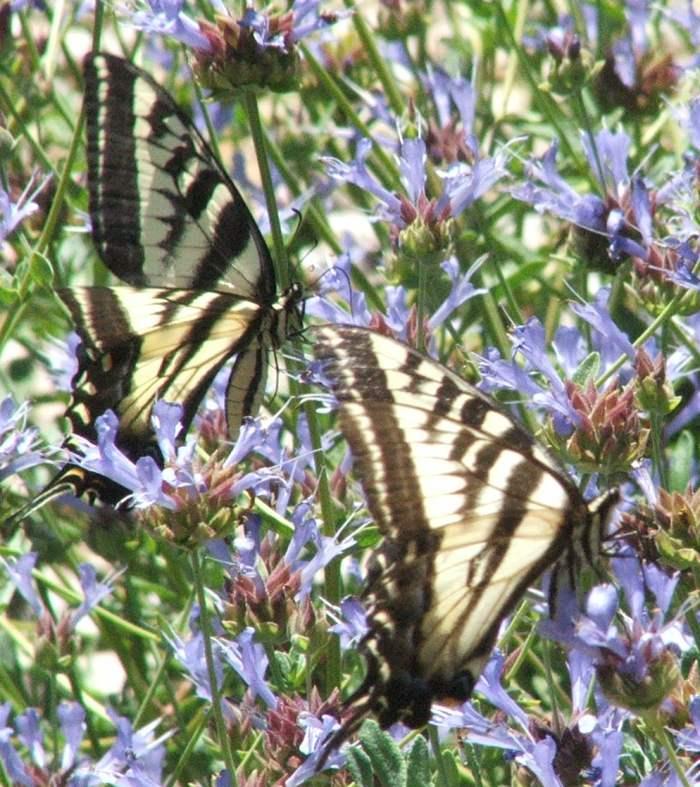
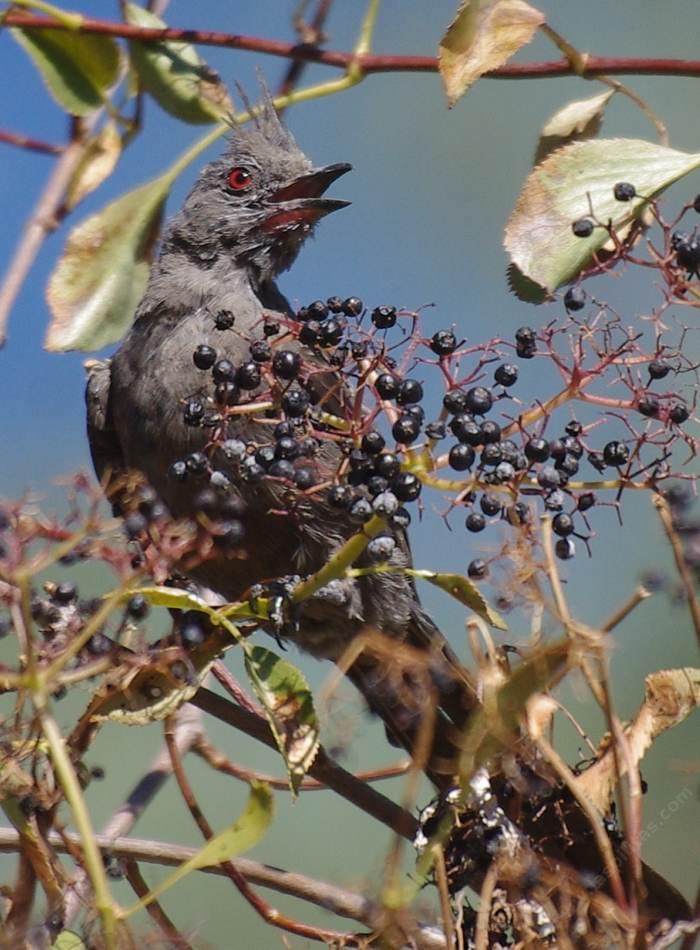
7. Seeds
There is a wide diversity of shrub seeds (Sages, Lupines, Buckwheats and Artemisias) and tree seeds (Pine and Oak are tops) that wildlife utilize. Plant a few of the plants, and you'll get pounds of seed.
8. Annual wildflower seed
(There are some dryland grasses that produce seed that may be used but they are a minor (approximately ONE percent) component in the southern half of the state) Poppies, Annual Lupines, Annual Sages, Annual Buckwheats, are far more important for the desirable wildlife, weeds and grasses are important for field mice and gophers. How to make a wildlife garden
The wildlife garden needs to be a mixture of trees,
shrubs, perenials, bare ground ( no weeds or debris between plants),
mulched, wet and dry. THIS IS IMPORTANT! The interface of this mix is
where most of the wildlife lives. That is why a small garden can
attract a large species list if you open it up into a series of
interfaces.
Sand-gravel walks lined with perennials mixed with boulders behind
which there are mulched beds with shrubs and trees. Every 30-50 ft.,
there should be a wet spot with a
birdbath under which there’s a mini-wetland with the overflow
into a shallow bowl or concave rock. Kill the weeds. The weeds stress
the system and will limit acorn and other native seed product. Kill the
weeds as the weeds do not support native animals, nor native plants.
Mow, spray or if it is a small area (3X3 is my limit) hand weed. Do not
till, disk, spade or fertilize. Common garden management leads to
common garden sparrows, cabbage moths, earwigs (I know some are native,
but really!) rats and mice. Native systems didn't have European weeds
in them before we showed up. Make your site a better site for the
wildlife and you by excluding the weeds.


Killer Cats
The wetland portion of the garden is surrounded by cat proof plants. (Is there such a thing as a “cat-proof” plant??????) We usually mix Ribes, Juncus, Carex, Acacia greggii, Mahonia nevinii, Snowberry, Mimulus, Satureja, etc. Your little cuddly kitty turns into the neighborhood furry terror as he/she wanders around the neighbor's yard eating their birds and visiting every flower bed leaving fragrant replicas of himself. When he gets done marking the spot, he’ll roll for a few minutes in the freshly planted flower/vegetable bed, digging around just to check it out. Then it’s time to hunt for the most beautiful, melodious bird in the garden. Hey, there's a birdbath, maybe a drink before dinner? Australia talked (briefly only as the little old ladies showed up in herds to protest) about killing all the kitties on the continent because of the impact on wildlife. ( They have an incredibly sensitive situation. Small marsupials don't mix with killer mammals.) If you do let your cat out to roam the garden, put a bell on it at least, a mask and cap would be cool too.
More good wildlife plants
The shrubs in your wildlife garden need small fruits and seeds the wildlife can use. These can be Toyon, Ceanothus, Currants, Lupines, Rhamnus, Artemisia, Salvia, Manzanita, Mahonia, Trichostema, Buckwheat, Malacothamnus, and many others.
The trees need to be sized and placed carefully. Pretend you’re Goldilocks and find just the right bed for just the right tree. Small trees can be Elderberry, Ceanothus, Redbud, Arctostaphylos 'Dr. Hurd', Arctostaphylos glauca, Scrub Oaks, (Quercus berberidifolia, Quercus dumosa, Elderberry (it's really important), Desert Willow, or Adenostoma sparsifolium, and did I mention Elderberry?, depending on what plant community you live in. For example, in the desert areas desert willow is perfect, as is palo verde, mesquite, etc.) In the coastal sage scrub elderberry, or Prunus ilicifolia, would fit right in. In the sierras or the coast ranges the redbud or one of the small shrubby oaks is unsurpassed. If you live in a former chaparral area then the Arctostaphylos or Ceanothus in your area would look beautiful, but blend in naturally and be a dominant feature around which you could plan the wildlife garden. Or mid-sized trees include Acer negundo, Acer macrophyllum, Pinus monophylla, Pinus muricata, Arbutus menzesii, Juglans californica, Fraxinus latifolia, Alnus rhombifolia, Large trees include Juglans hindsii, Quercus species, Pinus species,
** Note: For a cornerstone or key plant in the wildlife garden you may want to know the top 10 ranked plants in order of their value to wildlife. Many of these are trees or large shrubs.
3. Elderberry
4. Poison oak. POISON OAK???? Yes, poison oak is very important when it comes to attracting birds especially. If you have a corner somewhere or you or your loved ones are not allergic then it may be used.
6. Manzanita
7. Rhamnus species (Rhamnus crocea, californica, etc.)
Perennials can be very diverse and can be nectar sources, (Penstemon, Keckiella, Diplacus, Mimulus, Zauschneria, Salvia, Lonicera, Aquilegia, Antirrhinum, Lobelia Dunnii), seed sources, (Eriogonum, Cirsium, Lotus, Lupinus, Salvia, Artemisia), and berry sources (Ribes, Mahonia, Lonicera, Symphoricarpos).

Deer
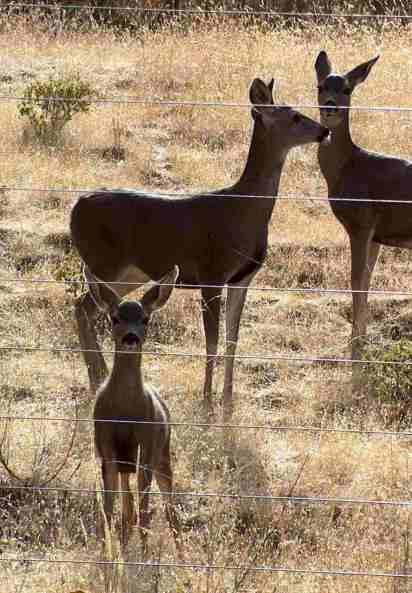
Some unusual people want to attract and support deer. Here are the basics:1. Kill the weeds. (I know but some people are slow.)
2. Work at systematically reducing the weed debris through mowing and long term weed control.
3. Put water sources in next to cool, shady north slope locations along with open spots with wide angles of vision.
4. Plant a few wet spots with sedges, rushes, monkey flowers, grasses and other expendables that can be browsed nightly by the deer. Deer have a normal range of only a mile or so. Give them at least 3-5, 200-300 sq. ft. ‘wetlands’ within that mile.
5. They prefer nitrogen- fixing shrubs like Ceanothus and Cercocarpus (search our site for nitrogen -fixing and you’ll get a few. A little extra summer water on these plants almost always means they’re browsed heavily.
6. In large open areas (5-50 acres) there are native species of Vetch that you should be able to get from S&S Seed. After you get your weeds under control, Vetch, Lupines and Poppies work well for a feed cover.
Wildlife Gardens have other benefits
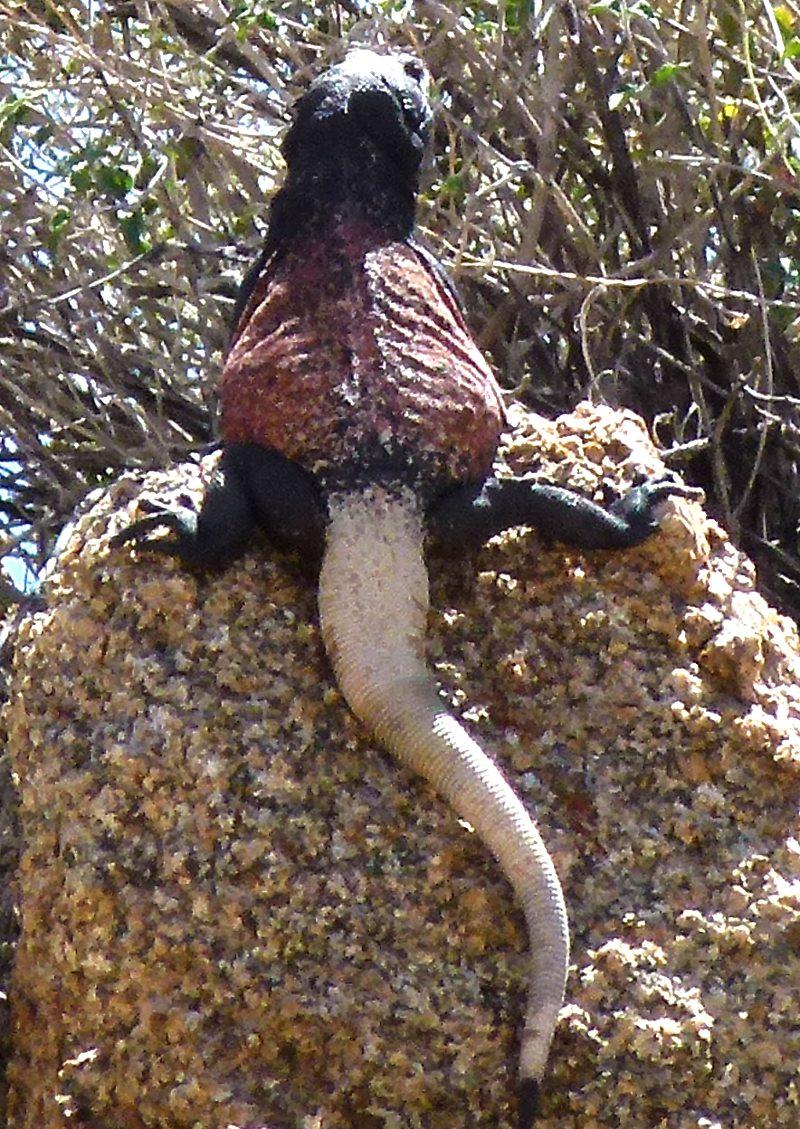
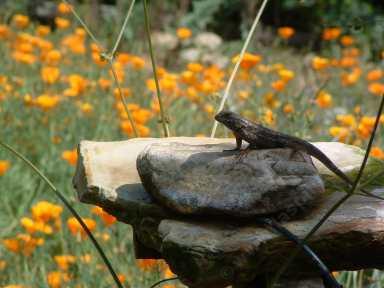
There are many benefits to having a wildlife garden, most of which we're just beginning to understand! Terrified of ticks and Lyme disease? The bacteria that causes the disease dies when it lives of a western fence lizard (Leopard lizards may also be helpful). (Talleklint and Eisen, 1999; Lane and Anderson. 2001.) High numbers of lizards and certain small mammals in the garden offer near-perfect protection. Weeds favor mice (one major vector); oak leaf and shredded redwood bark mulch and open paths favor lizards. Small mammals (Shrews, Moles, Foxes, Bobcats, Weasels, Squirrels, Gophers, and Rabbits) limit the populations of mice.(Ostfeld and Keesing, 2000) Put in small open 'trails' of crushed rock or decomposed granite with mulch and boulders in the planted areas, throw in a log or bench and you have a western fence lizard paradise.
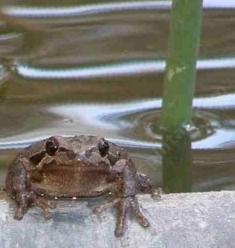
Amphibians like a pond or small marsh (under a birdbath; it has to be water, not just moist soil) to reproduce in, and cool moist areas in which to hunt insects. On good frog years we have very few insects (10,000 fly suckers diminish the fly population). There seems to be a correlation between native plants and amphibians. We think it may be a combination of the lack of native insects on non-native plants providing no food for the frogs, an irritant on the weeds or non-natives that harms the frogs, and/or pathogens associated with weeds and non-natives that the amphibians cannot tolerate. Basically, the problem is that the whole habitat is gone, from the microorganisms to the plants and amphibians, when there is no native plant community in place. We have thousands of frogs in the nursery; whole blocks in town have not one frog. Why? We do not think it is a chemical issue alone; that is, one herbicide nor one insecticide killing them all (some insecticides, and Atrazine herbicide that is used primarily on corn, are toxic, but these are not used by every homeowner, and poor farmer in the world). Amphibians are not helped if you apply chemicals on them. Many chemicals are absorbed readily through their skin. (Do not do your weed control when the frogs are out.) The removal of native habitats is happening worldwide, but the restoration of at least partial habitats, even in a garden, brings back the frogs.