How to build a simple bird bath to enhance your Garden.
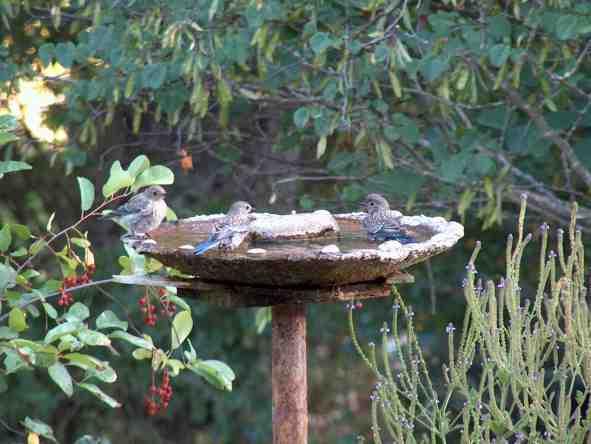
Over the years we've built a number of bird bath devices. Some bird bath plans were complex, some very simple, some quite stupid. Hopefully, you can build a bath that works for your birds.The hard part is getting it 'bird friendly'. Most of the birds do not like full sun, nor full shade. They don't like the bath fully exposed (hawks can get them) or in brush (cats can get them). If you put the bath under a tree, the tree can die of over watering. The bird brain is picky! Most birds prefer a bath that is partially exposed with very low vegetation under it but a tree or shrub nearby so they can land in the tree and hop or fly a short distance to the bath or fly from the bath quickly to the tree if danger approaches. Put the bath near the edge or dripline of a tree or bush that likes a lot of water. Bush Anemone (Carpenteria californica), Currants (Ribes spp.), Desert Willow (Chilopsis linearis), and Spice Bush (Calycanthus occidentalis) have all worked well. Make sure the location gets a little high shade from a building or large tree about 1P.M. Here at the nursery the birds enjoy the afternoon shade. Let the water drip onto Lilies (Lilium spp.), Rushes (Juncus spp.), Sedges (Carex spp.), Scarlet Monkey (Mimulus cardinalis) or other riparian plants. As you move away from the bird bath plant drier plants. Each bath can support a 20 to 50 foot area in plants and animals.
A metal support post works well. It doesn't have to be an I-beam. A piece of 3/4 inch copper pipe is OK. We built one out of a six foot section of 2 inch PVC. As long as the pipe doesn't have a lot of sway to it, it will work. When it sways too much it will not have any water in it on hot windy days. Wooden posts only last a year or so, as they rot with all that dripping water. However many acrobatic birds like the Wrentit and Oak Titmouse like to cling to the posts and sip the water that dribs over the edge of the birdbath. Wood gives them a good substrate to cling to and lots of crevices for bug snacks. The platform should be one inch by 12 inch wood, 2X6, 2X8, or tile. Make sure it doesn't wobble. One fat Scrub Jay can make the whole thing go over.
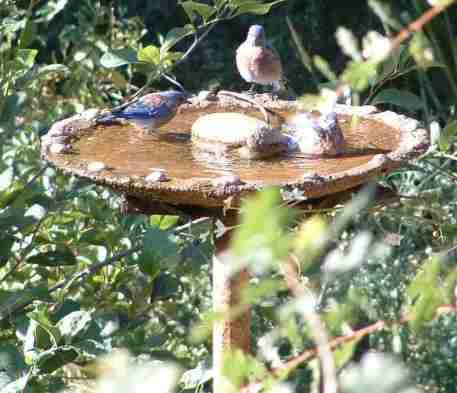
This bath is made of a thin layer of cement. A rock helps to stabilize it and holds down the drip line. A Western Choke Cherry, Prunus virginiana, on the right of the bath serves as a pre-bath perch. This one is kind of nice looking compared to the garbage can lid, however it has no chicken wire in it and will probably crack over the winter. To make this bath just make depression in some sandy soil and pour a thin layer of cement. Use a gloved hand or a trowel to spread the cement around the depression. Make sure you don't do this on a hot day or in hot soil or it will instantly crack. Give it a couple of days and carefully lift it out. You can press in pretty rocks to ad some character. To make a stronger more long lasting bath place chicken wire in the depressions before you add the cement.
Of course if you put one of the ugly things up, you'll have to hear about it from EVERYONE. My favorite is an old hubcap. It's kinda fun just to bug the uptight neighbors to put these all over the yard and then pull out the six pack, the old chaise lounge, the newspaper and watch the birds and the neighbors. Oh, it is required that you wear those bunny house slippers and maybe a frayed tee-shirt and cut offs.
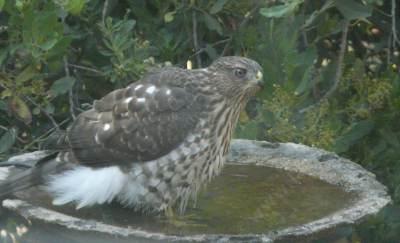
The bird bath can be a metal pie pan, glass cake pan, practically anything. Just make sure it isn't going to rust or poison the birds. Make sure there are no sharp edges. In mild climates ceramic or glass is great. (They will crack in colder climates.) Shallow pans favor small birds, deeper pans favor bigger birds. Before you get all excited and put a horse trough on a post, I've never seen an eagle at a bird bath. 1-2 inches deep is about right. The 2 inch deep bird bath needs a small rock in the middle for the smaller birds. It is best to have a dish with a very gradual incline, deeper in the middle. This allows anything that falls in to climb out easily. You don't want to drown anyone. Keep it shallow. Hawks use the smaller baths when it is REALLY hot and dry. Boy, the little birds freak when the hawk settles down for a drink!
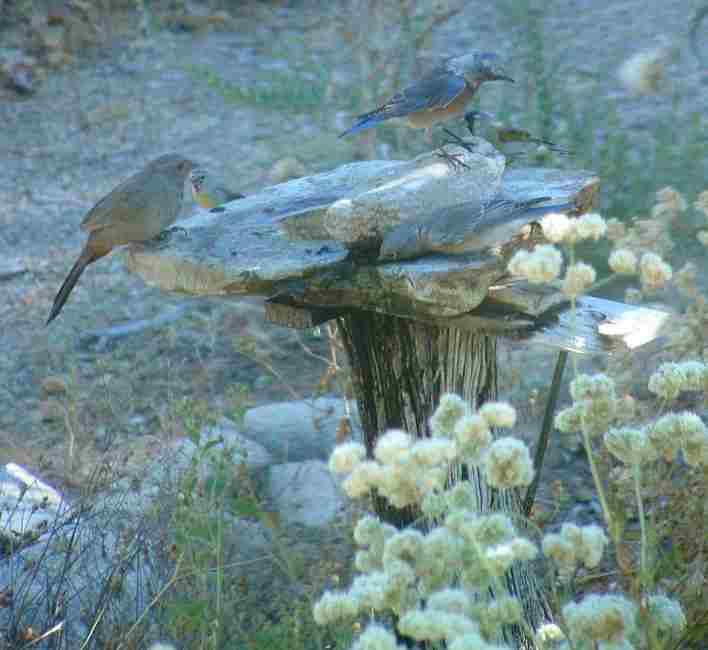
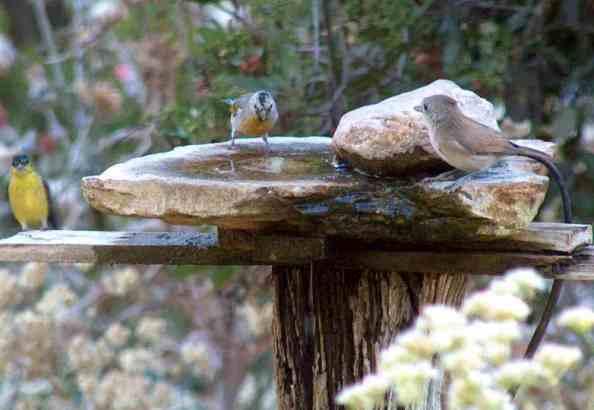
Where's the Diving Board? One Lawrence's goldfinches, a Lesser Goldfinch, and an Oak Titmouse stop for a drink. A Toyon, Heteromeles arbutifolia, serves as their nearby perch. Here they land and wait till the coast is clear. This bath isn't great for bathing only for drinks. Although many birds do like to stand in the middle and flap about. It isn't very effective. Make sure your perching plant can withstand constant water. Riparian species are preferable. This bath is about 6 ft away from the Toyon. Any closer and it would probably kill it.
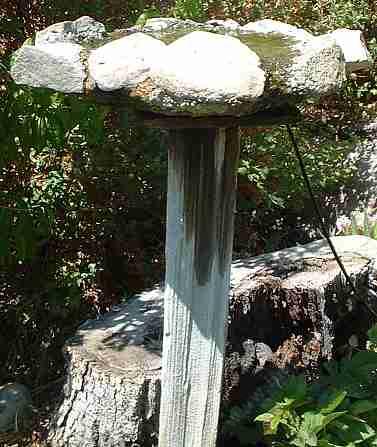
This birdbath was made out of a soft stone. The middle was scraped out to make a slight depression. (I used the teeth of a crowbar to scrape out a depression. I'm sure there is a better tool available, but that was on hand.) A small rock is used to hold the drip line down. It also helps to stabilize it. An old redwood fence post serves as the base. A couple of old planks of wood are nailed to the post to support the flat stone basin. We had a bet going o/n in the family that no bird in its right mind would go to it. As you can see, someone had to pay up. There isn't a lot of water for bathing but it is an excellent watering hole. The birds really like this bath. This is probably not so much the bath itself as the surrounding plants. There is a mature Toyon nearby that gives excellent cover as well as a snacking place. And a deciduous fruit tree that gives a good lookout point for seeing if the cat (a.k.a. killer) is out and about.
The basic bath structure is a simple post sticking out of the ground about four feet with a pan full of water on top. Light weight pans should have a rock in them or a lot of water to counter act the weight of a thirsty, fat bird.
Some way has to be arranged to keep the bath full. You can either adapt a sprinkler head to provide water to the bath or provide a separate little line for it. Unless you're really over watering your lawn, you probably are not putting enough regular water into the bath. Towhees and Western bluebirds like to splash about like they're at a pool party.
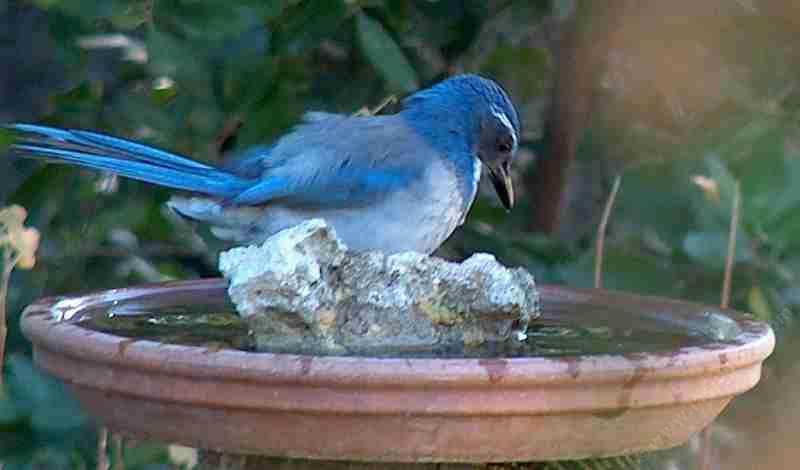
A faucet, or valve, with an anti-siphon device, a very low volume drip emitter that connects to same, and some quarter inch hose to connect the faucet to the bath is all you need. The water should, JUST, drip. If you can see it drip while you're standing there looking at it for 20 seconds, that's about right. If you can set the feed under a rock, it will hold it in place while adding an extra perch a.k.a. diving board. Hummingbirds prefer to get water while hovering. They sip the water as it falls over the rim of the bath. I have no idea why they won't sit on the rim.
With one one gallon per hour drip emmitter you can feed up to about 5 birdbaths. The trick is, they have to be at the same level. Exactly the same level. The lip of each basin has to be within a centimeter of the other baths. The baths can be a hundred feet apart, but they have to be at the same elevation. I've yet to find an float valve small enough to work in a bird bath. They are out there, I've just not found one.
Last of all, Be patient! It takes a while for the birds to become accustomed to the bath. They won't use it for at least a couple of weeks, until they know it isn't going to get them.