California Thrasher, Toxostoma redivivum
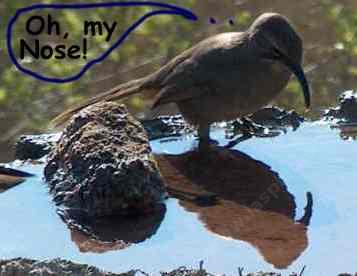
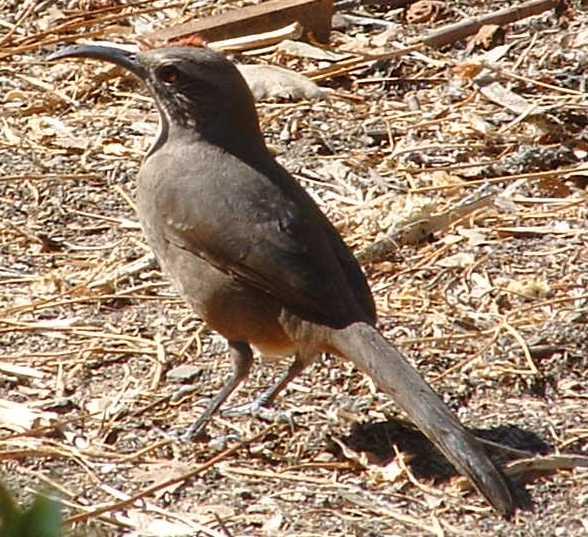
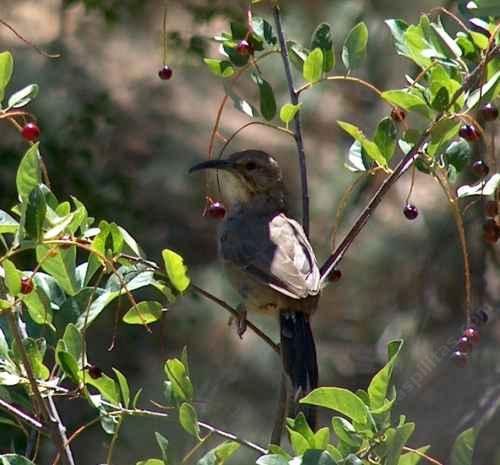
Although the California thrasher is fairly nondescript, it is one of my favorite birds. (His nose does give him away.) It has the most charming personality, and is captivating to watch. The California Thrasher has a beautiful song which in the spring it can be heard throughout the chaparral in California. And of course no one can forget that beak. It looks like a hay thrasher, hence the name.
The California Thrasher is found throughout California in the chaparral plant communities.
Diet of the California Thrasher
The California thrasher has quite an adaptation for feeding. If you can't spot it, you need glasses. The beak of the thrasher is long and curved and excellent for digging around in the leaf litter for food.
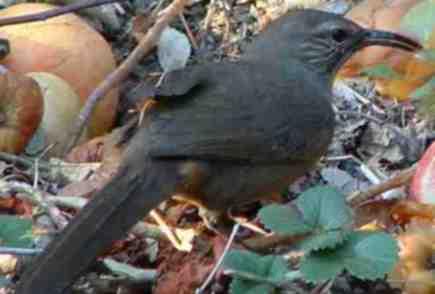
The California thrasher eats insects, spiders and other invertebrates it finds in the mulch. They also eat berries, fruits, acorns and seeds. In our garden one of their favorite plants is the golden current. It is covered with small red berries that turn black when they have ripened. The branches droop down low to the ground and the thrasher will pluck them off. They also love Toyon, Heteromeles arbutifolia . This is a tall evergreen shrub with holly like berries.
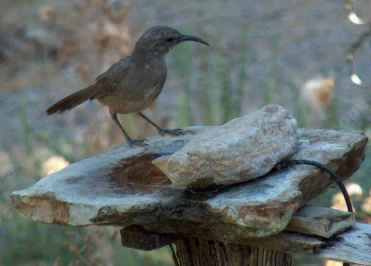
The California Thrasher will also use the bird dish.
The California thrasher likes to nest in dense shrubbery.
Plant communities used by the California thrasher
The California thrasher prefers chaparral but will also use neighboring riparian or oak woodland habitats.
The California Thrasher does not migrate.
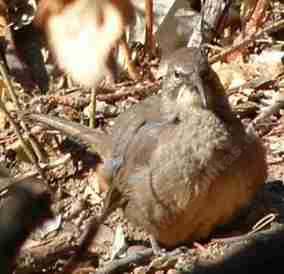
The California Thrasher is quite adept at filtering through the leaf litter.
How to attract the California thrasher to your garden
The California Thrasher likes leaf litter and berries. It does not like cats for obvious reasons. This bird spends most of its time on or near the ground, making it very susceptible to cats. Golden Current is an excellent choice if you want to attract thrashers. It forms a small and attractive thicket. It is covered with yellow flowers in the spring which are utilized by many insects as well as hummingbirds. Later, in spring, that mass of flowers turns to a mass of berries. These berries are not only edible but quite tasty. The California thrasher thinks so to. They are also fond of Toyon Berries. Toyon is a large evergreen shrub with bright red berries around Christmas time. Mahonia nevinii is also very popular with the California Thrasher. This is a prickly evergreen shrub with gray foliage, showy yellow flowers, and reddish-orange berries.
Learn more about California's flora from our front page.
Return to Bird page
Check out the butterflies