LAS PILITAS
How to's
The Nature of Deer Nature and Man, Fire Problems
Your Own Natural Fragrant Path Costs of Replacing a Lawn
Attracting Butterflies Naturally Attracting Birds Naturally
Planting Part I: over all planting Planting Part II: single plant planting
Know When To Plant Natives Do Simple Restoration
 

Replacing Your Lawn with low water use Native Plants

1.Formulate a plan.

2. COSTS

3.Differences in cost.

1. Formulate a plan.

A. Decide how much area is to be replaced and the low water use plant material (mostly native) to replace same.

B. Identify the weeds and how to control same. Purchase the herbicide needed to control same and apply.

C. Allow 1-2 months (minimum) of time to control the weeds.

cc.Water and fertilize the lawn area. The weeds can be killed only when actively growing. Do not try to kill bermuda grass when it is dormant.

ccc. When the grass is growing vigorously spray with Round-Up.

cccc. Two days later water and fertilize again. (The idea being that you need to germinate the second crop of weeds that did not emerge the first time.) Continue to water and fertilize moderately to heavily for at least one month.

ccccc. If nothing at all comes up, you are done with this portion and can now plant. If you see weeds , repeat the cycle.

D. If you have a sprinkler in place, retrofit it with a low water use (usually spot-spray) system by using adapters or change the heads to low volume/low water use heads. Plan on watering with spot-spray for 4-8 hours or with low volume heads (Toro 300-93 or Hunter Pro series with 1-3 nozzles) for 3-4 hours once per week for the first few weeks. (If the new plants match the site's requirements (rainfall, climate, soil, etc.) you only need to water twice a year, at the end of the rainy season, on most sites. Use this water to water in our pre-emergent weed control.). Place drip emitters 2-3 ft. away from the plants after the first year or the life of the plants will be undeniably shortened or altered.

E. Now set out your new plants. Plant them a distance apart that is about equal to their mature size less 10%. A good example is Baccharis pilularis 'Pigeon Point'. This plant grows to 10-12 ft. across and plants should be set out 10 ft. apart. Many people plant these 1-2 ft. apart and the plants climb on top of each other. If the plants are planted too close they will compete with each other and you will have dying/dead plants and weeds.... DO NOT use soil amendments. (Mulches are excellent; see below.) Plan for the average maximum height, so as not to have to prune anything.

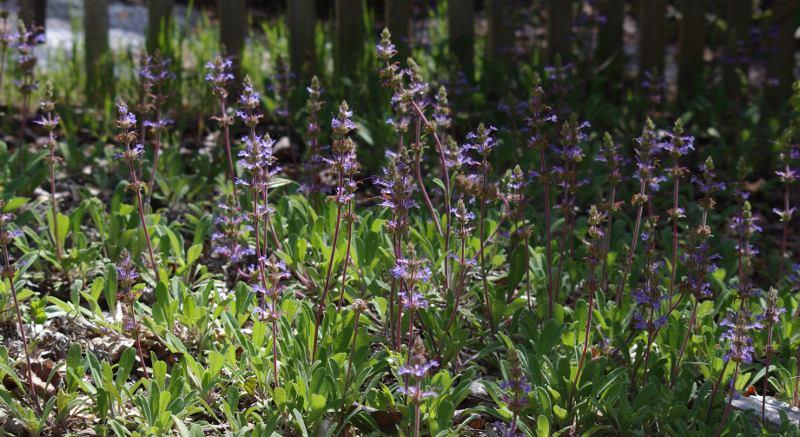
Drought tolerant Salvia brandegii and Purshia can be a showy mix.

F. Apply pre-emergent weed control over the area and then water it in.

These herbicides prevent about 98% of the weeds from germinating. They only stop root tip development in the top 1/4 inch of soil. (If you're a root tip they're toxic.) Keep an eye on the site or the 2% will bury you.

This whole scenario works the easiest if you start in the spring and plant the new landscape in the winter, but you can achieve the low water use anytime by turning the water off. Planting can be done all year.

The major problem in gardens is watering and the resulting weeds/dead plants. Do not water more often than once/week (after the initial watering). Go after the weeds with no holds barred, use your teeth and feet. If you manage control of the weeds the first year and maintain a pre-emergent program until the neighbors control their weeds, the landscaping gets real easy.

Mother nature 'sees' a lawn area as a fresh water marsh. Converting a fresh water marsh to a drier site can be very difficult if you do not pay attention to details. Use good mulch and low water use native plants that live in together your area.

Budget between 6-12 months time for heavy weed control in weed- infested lawns and extra money for mulches. Use rock mulches (boulders to +"sized gravel) for desert plants-grassland plants. Usually use shredded redwood bark/ coarse wood chips ( see mulch table in catalog) for forest plants. The mulch must be @3" deep to work properly.

In review:

A. Work out a plan of attack and planting.

B. Spray to control the lawn and weeds.

C. Stockpile the mulch.

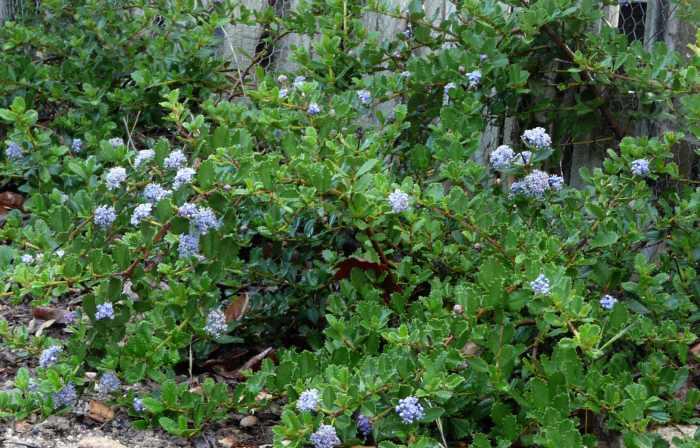
Ceanothus can be beautiful and add color to a California native garden.

D. When the weeds are controlled purchase our pre-emergent(s) and plants.

E. Mow off any debris, apply pre-emergent herbicide (and water in), and cover all with mulch.

(Do not till, make 'burial' mounds, fake creeks or install pink flamingos for the bird gods. The dead lawn will become part of the mulch.)

F. Move the mulch out of the way for each plant. Then remove the top one shovelful of soil from the hole(put that soil in an area where you want weed control) so that it will not be the shovelful that is put at the bottom of the hole around the growing root tips of the new plant. The next shovelful dig out and save, set our new plant into the hole, use our shovelful to fill in around the plant. Now spread the mulch back over the soil, bringing it near but not next to the base of the plant, and voila! When the whole site has been planted, water, water, water. This is the start- up for the system and is very important!

G. Check the soil ( one finger length down )under the mulch every week or so for the first summer(or dry period) . If it is dry, water. After the first year water only to apply pre-emergent or to bring the rainfall up to the level the plants need. (If the new planting is native to an area of 35" of rainfall and the rainfall in the planted area is 20" water during the rainy season to bring the total irrigation up to 35". Do not water in the summer unless: the new plants live in creekside habitats, the new plants are from desert areas(real low water use plants!), the new plants are from areas that receive appreciable amounts of summer fog drip (in this situation apply overhead watering for short periods of time to wet the leaves and the mulch and approximately the top + inch of soil .

Good Luck!!

With manzanitas and Ceanothus you end up with a green garden with flowers.

2. Costs, Take a Look At Variable Water Usage and Sprinkler Types.

A. If the lawn is 20' by 50', or 1000 sq. ft., ( most yards are about 3000 sq. ft.) and is watered 10 min. once/day, you will use about 8400 gallons/ month at a cost of between....$8.00 to $19.00/month

$96.00 to $228.00/year

B. If the same lawn is watered 15 minutes 3 times per week with Toro 570 or Rainbird 1800 sprinklers, you will use about 5400 gallons of water per month. ..............$5 to 12/ month

$61 to 144/ year

C. If the lawn is watered twice per week with Hunter #3 and #5 or Toro 300 for 60 monutes the water use will drop to 4500 gallons per month. ...............................$4 to 10/ month

$50 to 123/year

D. If the lawn is watered once per week for 90 minutes(which is what I recommend for the healthiest lawn) the water use drops to 3400 gallons per month....................$3 to 8/ month

$38 to 93/year

E. Using a conventional sprinkler that uses 8gal/min and covers an area 15'round (moved six times at 40 minutes/), water use would be about 8000 gallons/month.........$8 to 18/month

$90-219/year

F. Using an oscillating sprinkler for 90 minutes once per week the water use would be about 3900 gallons/month.(This will leave the margins a little burnt, but be ok for old established lawns of bermuda grass or weeds.)...............$5 to 9/ month

$63 to 107/ year

G. Hand watering daily for 45 minutes with a hose will use about 13,000 gallons/month(shocking isn't it!). $12 to 30/month

$146 to 357/year

H. If the lawn is replaced with a groundcover planted 5'apart, put on 1 gallon/hour and watered 4 hours/week, the water use is 700 gallons per month.......................$.65 to 1.50/month

$8.00 to 18.00/year

3. Differences In Cost.

A. A 20-50' lawn with an automatic system costs (if you install yourself), per year with a 20 year life.

1. Seed and topping .(with labor at $4.00)................$5.00

2. Sprinklers(Toro 570) & Timer...(labor at $4.00).......$25.00

3. Lawn mower,(lasting 10 years).........................$55.00

4. Time to mow(at minumum wage $4.00).(45 minutes,mow&edge)

$156.00

5. Water(65,000 gallons/year at $.7 /100cu.ft.).........$61.00

5a. (65,000 gallons /year at $1.71/100 cu. ft.).......$150.00

6. Fertilizer and sprays................................. $25.00

Total/year.........................Total for ten years..............................

Aa. A 20-50' lawn with an automatic system costs (if you have it installed), per year with 20 year life

1. Seed and topping(with labor of leveling at $25/)..... $15.00

2. Spinklers(Toro 570) & Timer (labor at $25/)...........$45.00

3. Lawn mower,(lasting 10 years).........................$55.00

4. Lawn maintained professionally.......................$600.00 5. Water(at $.7/100cu.ft.)...............................$61.00

5a. Water(at $1.71/100 cu. ft.).........................$150.00

6. Fertilizer and sprays.................................$25.00

Total/year..............................................$801.00

Total/ 10 years........................................$8010.00

B. A 20-50' groundcover using an automatic system(if you install it yourself), per year (a ten year life).

1. Plants(Arctostaphylos Hookerii'Wayside')$4.00/X 40.....$16.00

2. Sprinklers (first class drip, pvc, not polyethene, poly is cheaper but gophers and people cut it).(labor at $4.00)....$35.00

3. Preemergent(a weed killer that stops weeds).............$10.00

4. Time to weed (at $4.00/hr.)(35 min./week).............$104.00

5. Water(8400 gallons/year at $.7/100cu.ft.)................$8.00

5a. Water( at $1.71/ 100 cu. ft.)..........................$19.00

Total/year................................................$172.00

Total for ten years......................................$1728.00

Ba. A 20-50' groundcover using an automatic system (if you have it installed and maintained), per year (ten year life).

1. Plants..................................................$16.00

2. Sprinklers(as above installed at $25.)..................$75.00

3. Professional Maintenance ..............................$360.00

5. Water....................................................$8.00

Total/year................................................$459.00

Total/10 years...........................................$4590.00

C. A deck 20-50' cheap redwood on the ground using treated wood joists and concrete piers, per year (15 year life).

1. Materials @1500.00..(labor at $4.00)..............$120.00

2. Stain (done every 3 years)..............................$25.00

3. Sweeping (at $4.00).....................................$52.00

Total/year................................................$187.00

Total for 10 years.......................................$1970.00

D. Brick patio 20-50', at $.32/brick, on sand, per year (30year life).

1. Bricks.................................................$43.00

2. Sand....................................................$1.00

3. Edging..................................................$3.00

4. Labor (at $4.00 for yourself)...........................$5.00

Total/year................................................$52.00

Total for 10 years.......................................$520.00

If you haven't figured it out yet, this was writen in 1981. The numbers are off because of inflation, but the ratios are, if anything, more dramatic now. The yards I installed in 1981 still look good and have saved the client more than the numbers here state. Low Water use leads to low maintenance, which is cheap over a 10 years period.

laspilitas.com
Copyright
Las Pilitas Nursery
Santa Margarita - Escondido