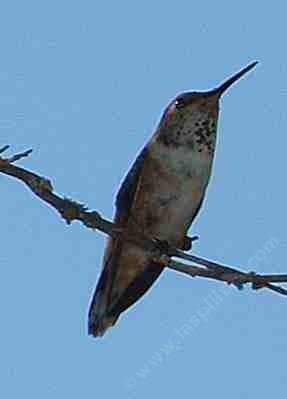
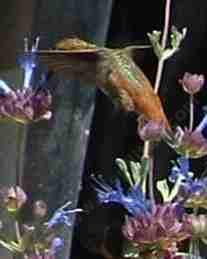
Allen's Hummingbird, Selasphorus sasin
Range of the Allen's hummingbird
The Allen's hummingbird is found on coastal California into coastal southern Oregon in the summer.
Migration of the Allen's hummingbird
The Allen's hummingbird spends only the summer along coastal California. They spend the winter in Southern Mexico and a small population on the coast of California around Santa Barbara.
Diet of the Allen's Hummingbird
The Allen's hummingbird eats mainly nectar occasionally eating spiders and insects it finds in flowers. These spider and insects provide a source of protein for the Allen's Hummingbirds. They need nectar sources with high amounts of sugar to support their incredibly high metabolisms.
According to the University of Michigan's diversity web the Allen's hummingbird visits approximately one thousand flowers per day and needs to consume more than twice its own weight in nectar each day.
Flowers that are favored by hummingbirds usually are not as popular with bees, as bees want wide floral tubes for easy access. Hummingbirds, with their long bills and tongs can extract nectar from a great depth. Here are some of the hummingbird's favorite flowers: Salvia spp., Penstemon spp., Aquilegia spp., Mimulus spp. and Diplacus spp., Zauschneria spp., and Stachys spp.
Nesting habitat of the Allen's hummingbird
The Allen's hummingbird has very general nesting requirements. They will nest in trees, shrubs, or herbs. Their nests are very small and tightly woven cups.
Plant communities used by the Allen's Hummingbird
The Allen's hummingbird can be found along coastal areas in wooded areas.