How to build a simple fence.
What do your need the fence for? Can the same effect be acheived with bushes and trees? How high will the fence need to be? Is there a city or county limitation on your fence height? This is commonly 6 feet on side and back yards, 3 feet on street corners and 4 foot in the front. Will the fence create an access, shade, view or wind problem? Is the fence on top of a drainage problem? Need to move something big into there later? What material is affordable, looks good and you are capable of constructing? Can you dig the holes? This sounds stupid but I bid a couple of fences where there was solid rock six inches down. Talk about working hard for free! A number of cities have adobe. If you're a grandpa, you'll get one hole dug a day. Since you need a post every eight feet, it may take you awhile. If you want chain link, have it professionally installed (but you may need to rob a bank to pay for it). When labor was cheap, chain link was cheap. Now it costs a little more than a wood fence for a ok chain link, double wood for a good chain link(one with the top pipe runner).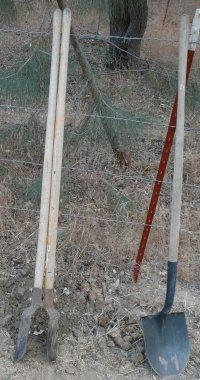
A Post hole digger and shovel.
Rock Walls.
Many sites have rocks EVERYWHERE! In older times the poor farmer would have his kids pick the rocks from the field and he'd build a 'fence' with them. After few years of picking rocks from the field the kids figured they needed to go to college in another state and the farmer had a really nice wall/fence. In some areas you can buy rip/rap that they use to stablize creek banks for reasonable prices. A truck and trailer load of bolders can cost as little as eight or ten dollars a ton, delivered. But, having twenty tons of 3 foot bolders delivered onto a new paver drive way can cause some problems with uneven driveway. How do you you move a 400 lb. rock? Almost as bad is the pile of 3-6 inch round river cobble, it's great for making edging and cobble 'paths', but a pain in making walls, near impossible for making fences. If they deliver the small rock, then we use plan B. Plan B is to pour footings, a six inch deep by 18 inch wide strip of contrete with wire or rebar in it with bits of wire sticking out to attach the rock to. Frame a six inch wide moveable frame of plywood in two sections eight foot long. It doesn't have to be prefect for a low wall, it does have to be perfect for a fence. Anyone can build a one or maybe even two foot rock wall. A six foot rock 'fence' is an entirely different matter. First quarter calculus is easier. (Second quarter wasn't.) A one or two foot rock wall with a four foot wooden 'fence' on it is wonderful. Dogs can't dig under it, the wood doesn't rot, and you end up with a great setting bench.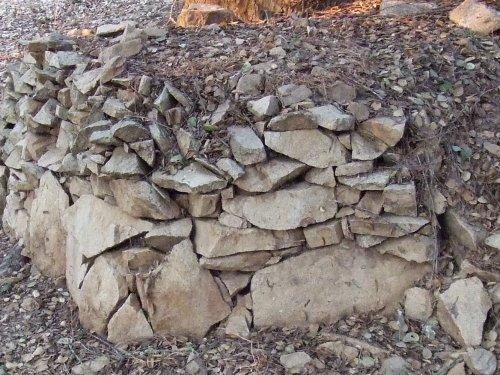
If you have rock everywhere, why not put them together as a rockwall or garden wall?
Wooden fences or wooden posts
The big thing about wood fences is the posts and runners. If you use cheap posts the fence will be on the ground in less than five years. Use cheap runners and the fence will be so warpped you'll wish it was on the ground. Use pressure treated posts, not peeler posts that are rolled in a dip. If you use wood, buy it from a 'real' lumber yard where the posts have been unbanded and in the sun for at least six months. The discount yards turn the wood from the mill to you in as little as a week. The wood commonly will look like a pretzel after six months, a fence of pretzels is an interesting, if ineffective, fence. This is true of the railings and runners also. The boards themselves can warp and be a pain but they're nailed onto the runners so they can't move too much. I've seen a 'fresh' fence that looked like a mangy three lagged cat with its fur up. The wooden posts should be 'planted' in soil. If you use metal posts for corners or bracing they should be cemented in. The cement is alkaline and treated posts that are cemented in rot off significally faster than posts placed directly in the soil. In some soils they rot off and make a wobbly fence in three or four years. Who wants to do this again? ( Take everything down back to the nearly solid post on each side of the gap, reset post(see next paragraph) and rebulid runners and boards. OR, drive metal posts in next to the rotted ones and nail or screw them together.).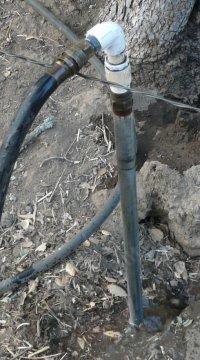
Post Hole helper. Our ground is so hard in the summer you cannot drive a tee post into the ground. The post bends and you get tired.
A simple pipe connected to a hose makes a tamping or hole digging much easier.
Put the Post Hole helper next to the string on the ground and blow out a hole.

The wooden posts become much more stable with a few nails or screws driven into it's bottom.

Put a little dirt in and tamp it, a little more and tamp. Continue until you fill the hole in.
Planting the posts consists of
1.Driving a few 10-20 penny galvanized nails or screws part way into the posts below the final grade level. Low on the post holds better, high on the post stablizes better. A few here and there is best.2. Digging a hole big enough to handle the post and the nails sticking out of it . A three or four foot 1" or 3/4 inch pipe connected to a hose can really, really help you dig you holes. Use the water to blow a two foot holes into the ground, in really hard soils, fill the hole several times before you finally dig.
3. Putting post into hole and hard tamping it as you back fill the dirt. Do not fill the hole and tamp it, fill three inches of the hole, tamp, three inches, tamp, and so forth.
For a six foot fence, you'll need a 7 foot post buried one and half feet. A runner goes about one foot above grade level and a top plate or runner goes at the top of the fence. The easiest fence for a novice is to place the 2X4 runners on the outside of the 4X4 tread posts matching the ends of the 2X4's as you run along the fence. You'll need a pocket level, some string, a nut or fishing weight and two 2X4's to set you posts. Put the corner posts up first, make sure they're level(don't measure the top of the post, put the level against the side of the post, there should be a side level). Drive a small nail in about and inch into the top far corner of each corner post and string the posts. (Don't pull the string so hard as to pull the posts over, but you tamped them, right?) If two of you are working pull and tape measure along the string and mark the sting every eight feet ¼ inch. Sight your hole by putting your fishing weight or medium sized nut on the end of six foot of string and using it as a plumb bob. Be careful not to fudge the string either vertically or horizonality, if the wind is blowing hard use a heavier bob. If it's really blowing you will have to use the 2X4 vertically and use the side level for that. Dig your holes off of the bob and 2X4's placed end to end(to check your bob) check your level on the post with every tamp. (If Bob's doing it, check Bob.) The hardest part of a fence is getting the posts in the right spot and level. After a few posts, get up, and walk back looking down the string. They sometimes look fine, until you get a little ways back.
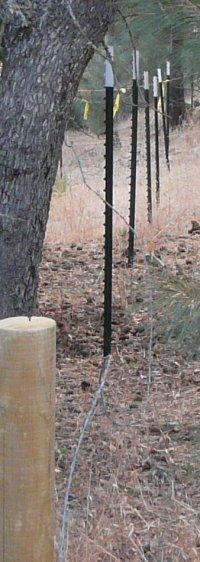
When you either pound in the posts or dig the holes for the posts,
do not worry about the top of posts following a tight
string, the base each post should follow a string
along the ground.
OR, if your're doing metal tee posts you can hold the tee post lightly by it's top and use it a level to find the spot for the post hole from a head high string.
Sometimes there's just to much in the way to do a ground string.
OR, if your're doing metal tee posts you can hold the tee post lightly by it's top and use it a level to find the spot for the post hole from a head high string.
Sometimes there's just to much in the way to do a ground string.
If you wish to be organic, use galvanized steel posts and real wood like ceader, redwood or fir above the ground. You'll need to cement the posts in. And we predrilled holes for attaching the runners. You'll find it easy to drill the holes if the post is laying on the ground on an old board or one of your fence boards. Try not to drill into the dirt, bits get dull faster than a fund raiser. If you use screws that are slightly shorter than the post and 2X4 runner you can screw through the post into the wood and have no sharps hanging about.

The metal post attached to the runner.
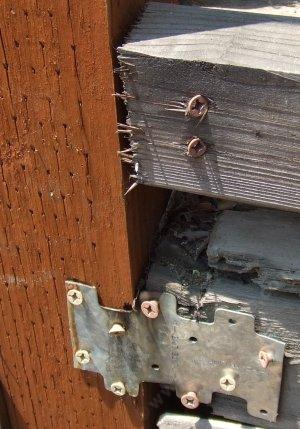
Metal clips can help attach runners and pots. We still toe nail, but the clips can make the corner stay together when a board warps or a horse scratches their donkey on it.

There are all sorts of metal connectors that can make things easier.
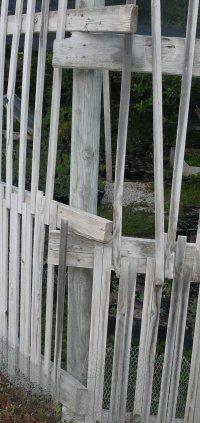
Fences and gates are pretty much the same in wood or wire. At least look at the pictures of all the fence related pages before you start. I hope this helps.
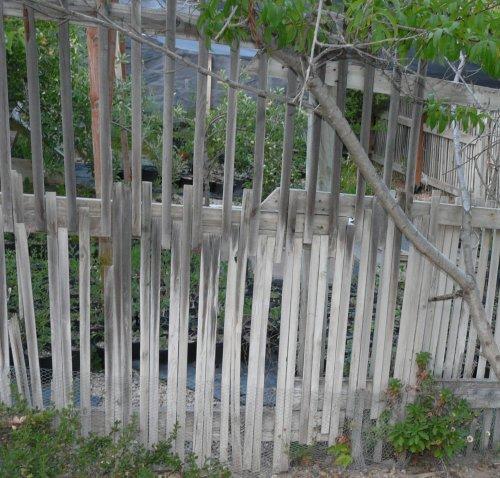
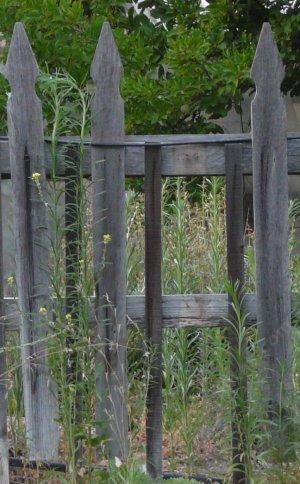
Sometimes tacky material can make a, quaint fence.
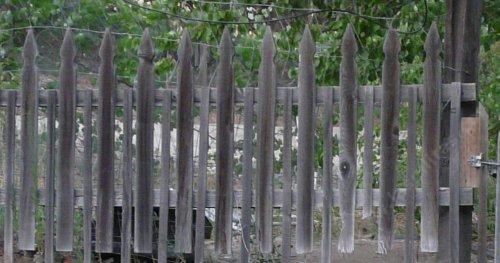
You can buy pre-assembled ten foot fence sections. But if you do not screw them together or put wire behind them the fence will not keep things in or out.