How to build a Bluebird house.
Also see the Western Bluebird page
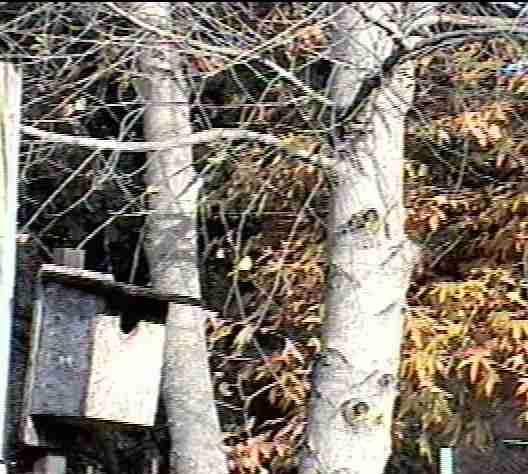
Start with good, clean (no paint or stains or chemicals) real solid wood (aged exterior plywood seems to be ok), preferably old stuff that has had some use and is rough. It needs to be natural wood, not plastic, metal, glass, or that high resin smooth stuff, but at least 5/8 inch thick cedar, redwood, pine or fir with rough surfaces. We have had problems with bluebirds and other birds not being able to exit the nest box because the inside surfaces of the nest box were so smooth that the bluebird could not get a grip. Several shallow cuts with a saw or some elbow work with a rasp should be enough if you're using new wood. Also, make sure the wood doesn't have spikes or nails sticking out, or in. Bluebirds are wild and can have weird reactions to plastic, paint or even Dacron or rayon. Please no perches on the front of the bluebird house; bluebirds do not need a perch to enter or exit the house. In the wild, bluebirds live in holes, or cavities, in trees and there are no perches available. Once you do build a bluebird house, you can watch the bluebirds fly in and out so gracefully you will see what I mean about no perches. It's amazing there are not bluebirds stuck against the back wall like darts on a dart board.
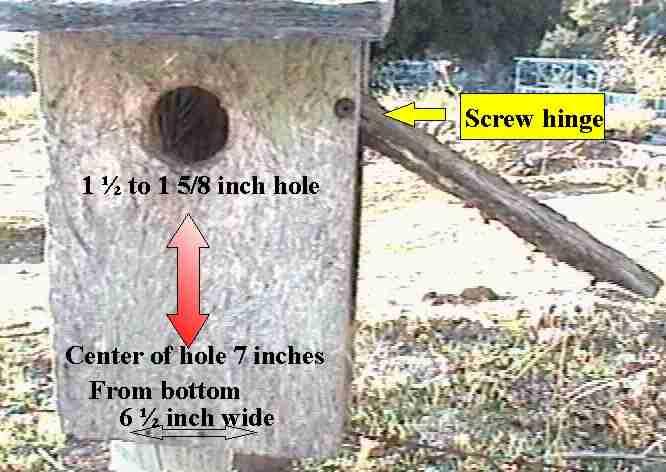
Size is somewhat important, but bluebirds do not seem to mind if it's not perfect. A crooked lean-to that has tight sides and top, an entrance hole with a diameter size of one and one-half inches, and put at the right site will almost always have a bird in it. If not a Bluebird, maybe an Ash throated Flycatcher, tree swallow, plain titmouse, wren, or other native bird. It's still a life support system for a desirable bird. Note: Ash-throated flycatchers and plain titmice have nested in bluebird houses in our area, usually after or before the bluebirds.
Mice can be a problem if the weeds are allowed to grow too high against the bluebird house post or in large numbers in the area. Bottom vent holes need to be small, no more than the corners trimmed. Mice and even snakes get into the bottom holes if they're very big. That's pretty exciting when you check the boxes....

Aspect of a Bluebird Nest
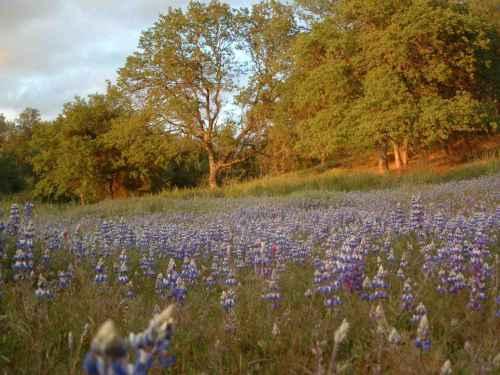
Location, location, location! The real estate must be good or it won't sell. Please face the bluebird house away from the prevailing wind. This is usually facing the entrance hole slightly to the southeast. The area in the front of the nest house should be very low, herbaceous vegetation only, for as far as possible, (the area we use has annual lupines (Lupinus nanus), tarweed (Hemizonia pentactis), clarkia (Clarkia purpurea), and needle grass (Stipa cernua), etc.) except a perch about the height of the house or close to it (4-6 ft. is optimal for the house) and about several feet away from the front, or side of the house, so that the young birds can make an easy first flight. If there is no natural perch then I place a fence post in the ground at the appropriate spot. Western bluebirds seem to like the house situated in the sun, or at least no thick vegetation directly over the house. Bluebirds don't mind having their houses put on a tree, as long as the canopy is high or very open. Bluebirds don't like thick vegetation near the house. Bluebirds don't like bodies of water in front of the house. Attach the house with a screw to a smooth steel post or a wooden post.
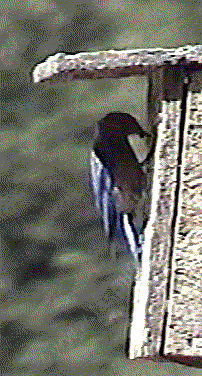
Parasites seem to occur in greater numbers in moist shady spots. Some of the parasites that affect western bluebirds are maggots of blowflies (pretty gross), blood parasites, and even bacterial enteritis.
Cleanout of Bluebird Nests
From the literature (and our experience) it looks like so far that western bluebirds will use the same nest for 3-5 years (in our central California coast ranges area), (it takes lots of time and energy to build a nest just like it takes a lot of time and money to build a house) and then the parasites become a problem and the birds will avoid the nest. Then we remove the nest and clean out the nest box with a dry cloth or whisk broom.

Bluebird Habitat
Western bluebirds in california prefer open woodlands. they do move into more lowland areas the winter. western are not found eastern desert of or lower portion san joaquin valley highest mountains.>
The preference of western bluebirds is to nest in open woodlands, of oaks,(usually valley (Quercus lobata), blue (Quercus douglasii), engelmann (Quercus engelmannii) or coast live oak (Quercus agrifolia), or conifers, (eg. gray (digger) (Pinus sabiniana), coulter (Pinus coulteri), and bishop pine (Pinus muricata)) or trees such as sycamores (Platanus racemosa), cottonwoods (Populus fremontii, P. trichocarpa), ashes (Fraxinus spp.), where there are no to few shrubs and mostly low herbaceous plants.
Bluebird Diet
Bluebirds eat mainly insects such as grasshoppers, katydids, etc., beetles, caterpillars, ants, and others.
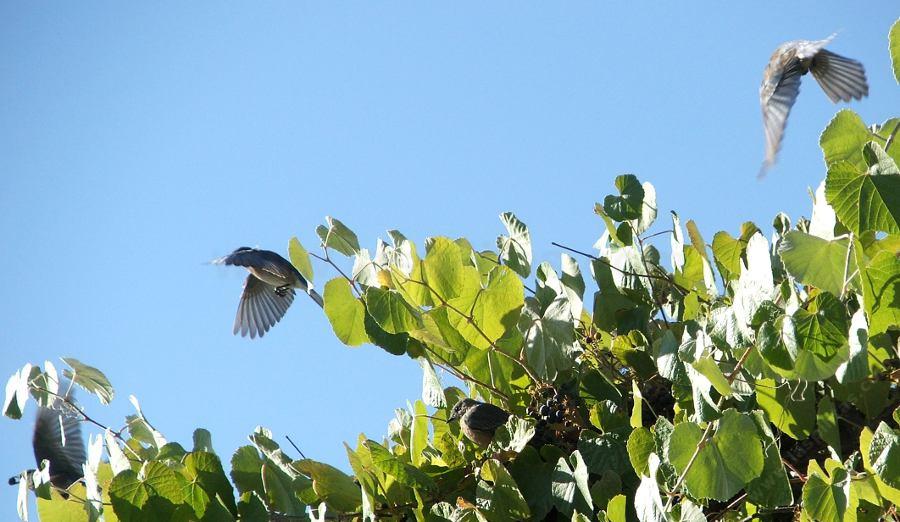
In the later fall and winter when insects are more scarce bluebirds add to their diet by eating the berries of mistletoe (found on oaks (Quercus spp.), pines (Pinus spp.), firs, (Abies spp) incense cedar (Libocedrus decurrens), juniper (Juniperus californica), etc.), and the berries of elderberry (Sambucus mexicana), poison-oak (Toxicodendron diversilobum), Toyon (Heteromeles arbutifolia), oregon grape (Mahonia nevinii, etc.), and redberry (Rhamnus crocea and Rhamnus ilicifolia), etc.

When you think of western bluebirds and nesting think of a few large trees or shrubs and open areas with low, non-woody plants. A good example is an open area of grass and herbs with bare ground in between the plants with a few trees dotted around here and there. The problem is that most of California is covered by alien, annual grasses that will only be fair habitat for the western bluebird if the grass is kept under control by grazing animals, weeding humans, or mowing humans! It is very difficult to spy an insect and even harder to catch it and then fly away, not to mention seeing predators coming to eat you, hampered by tall, thick, clumps of alien grasses. If you can get rid of the alien, annual grasses and replace them with native grasses so much the better.

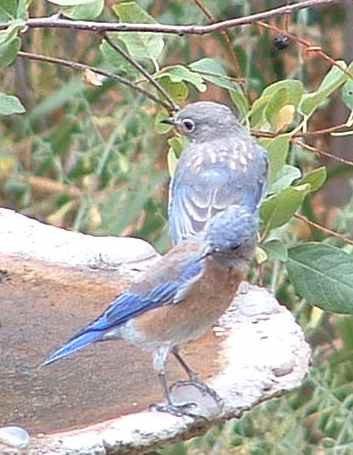
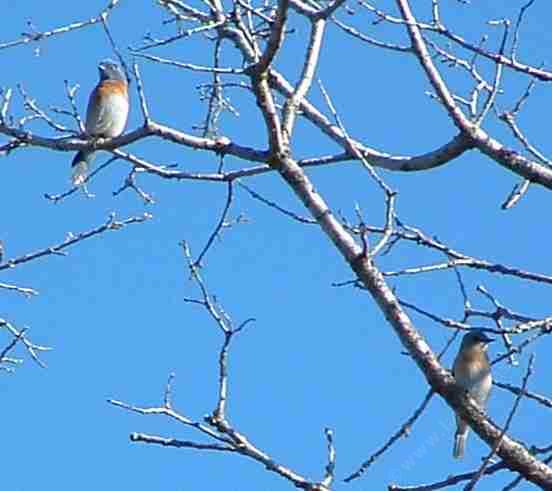
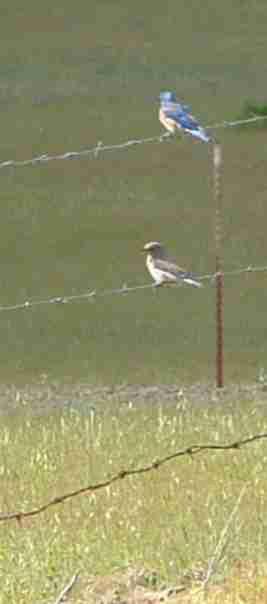
Bluebirds perch in a tree or on a fence post or whatever is handy and wait and when they spy an insect, the bluebird will gracefully swoop down and capture it and fly back up to the perch and eat it.
Bluebirds will also sit on a perch and when an insect flies by, the bluebird flies out and captures it in the air. Makes it look easy.
Bluebirds will perch in a bush loaded with berries and pick off several berries close by and then move to another spot and pick off several more berries, etc.