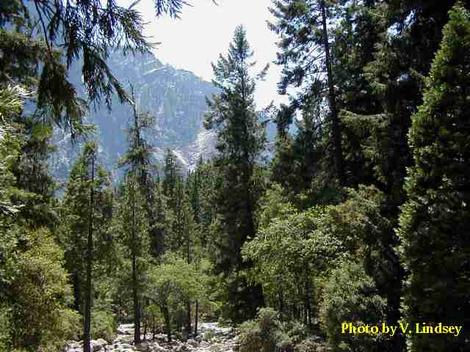
see also Habitats
Mixed Evergreen Forest
Annual precipitation:
20-60 inchesCommon Animals:
Steller's Jay, Deer, Gray Squirrel, Raccoon, Badger
Common Plants
Bigleaf Maple (Acer macrophyllum), California Bay (Umbellularia californica), Christmas Berry (Heteromeles arbutifolia), Coulter Pine (Pinus coulteri), Tan-Bark Oak (Lithocarpus densiflora),, Canyon Live Oak (Quercus chrysolepis), Black Oak (Quercus kelloggii), Coast Live Oak (Quercus agrifolia), Madrone (Arbutus menziesii), California Hazelnut (Corylus californica), Coffeeberry (Rhamnus californica),
Soil and climate notes:
Very diverse, but usually acidic clays to loam
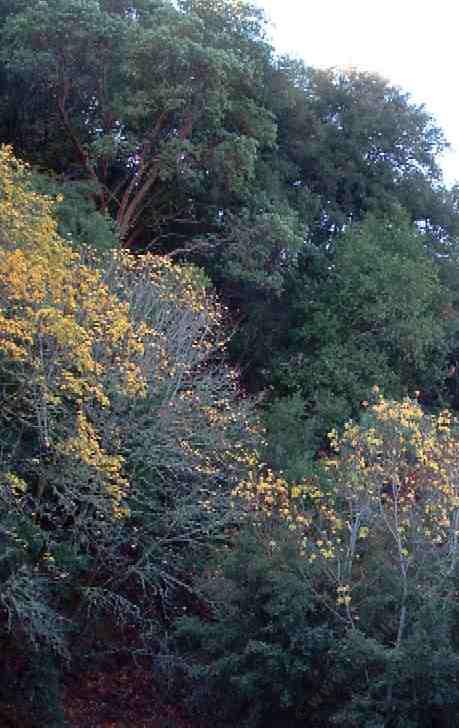
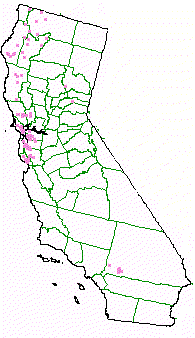
The Mixed Evergreen Forest plant community is found mostly in the
northern coastal mountains of California, though extending down to the
central coastal mountains. Some of the component species include Tanbark
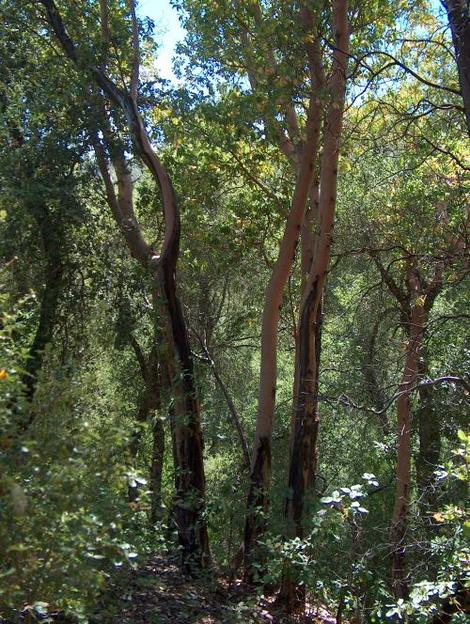
Oak (Lithocarpus densiflora), Madrone (Arbutus
menziesii), Douglas Fir
(Pseudotsuga
menziesii), California
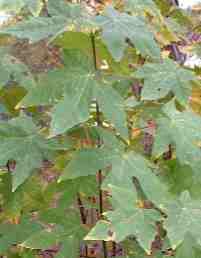
Bay (Umbellularia californica), Bigleaf Maple
(Acer
macrophyllum), Canyon Live
Oak (Quercus chrysolepis), Black Oak
(Quercus
kelloggii), Coast Live Oak
(Quercus
agrifolia) and California
Hazelnut (Corylus californica). This forest is filled with
leafy trees and few conifers. This makes for a softer looking forest.
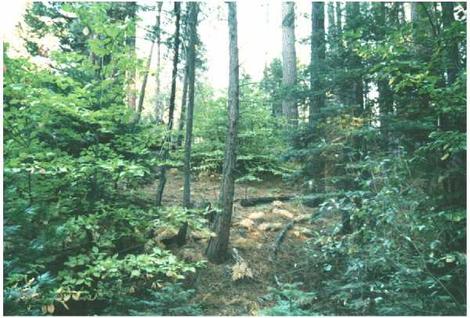
However this forest is not really that soft. There is often a dense
understory of brush and a canopy containing several species of oak
(It's so dark you have to use a flash in the middle of the day to take
a picture.)
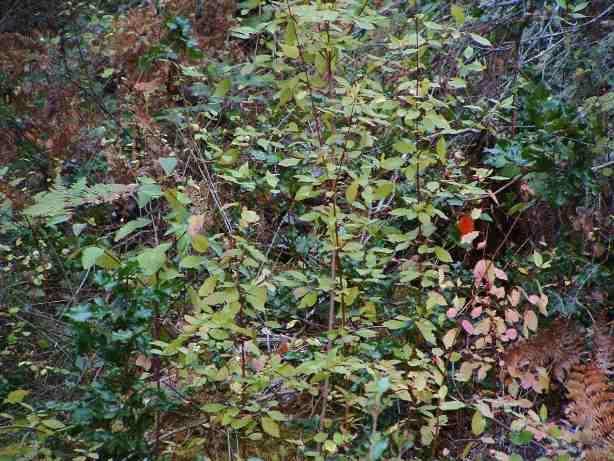
An understory of Oregon
Grape
(Mahonia
pinnata), Redtwig
(Cornus
stolonifera ) or American
Dogwood (C. sericea), Ninebark
(Physocarpus
capitatus) at the southern edge of the range of Mixed Evergreen
Forest.
The rainfall in the Mixed Evergreen Forest can vary anywhere from 25 to 65 inches. The temperatures within the Mixed Evergreen Forest are mild although not as mild as the nearby redwood forest. This plant community is like Seattle, wet and drippy many weeks of the year, and days commonly do not warm up. Lows below 20F are very uncommon, highs above 90F are very uncommon. A winter day can have a low of 28F and a high of 40F. A summer day can have a low of 55F and a high of 85F. Humidities are almost always 50-80%.
Many of the components of the Mixed Evergreen Forest are also found in the Yellow Pine Forest as well as the Redwood Forest. The Mixed Evergreen Forest has a wonderful fresh smell given off by the aromatic California Bay (Umbellularia californica) (or California Laurel ) trees. The dense brush and thick evergreen trees are an excellent habitat for birds. There is an abundance of food for wildlife in the form of various acorns as well as California Bay seeds. See http://www.laspilitas.com/bird.htm for more bird information. In some areas there exists nearly solid serpentine soils. Where the conditions would normally dictate Mixed Evergreen Forest, there is a mosaic transition, depending on soil depth, the amount of serpentine rock, and location in California, to Northern Coastal Scrub, Coastal Sage Scrub or Chaparral and then, to a serpentine grassland. We do not separate this as a community because the serpentine plant community is usually the plant community that is supposed to be there, minus the plants that cannot tolerate serpentine. On real 'raw' serpentine areas this will be nearly all seasonal forbs, grasses and bulbs that occur in the adjacent Northern Coastal Scrub, Coastal Sage Scrub, Chaparral, or Mixed Evergreen Forest. The serpentine soil just brings the plant community to extremes. In the Mixed Evergreen Forest the trees and shrubs Coulter Pine (Pinus coulteri), California Bay (Umbellularia californica), Coffeeberry (Rhamnus californica), California Lilac (Ceanothus papillosus or C. foliosus) give way to bald spots full of bulbs such as Mariposa Lily (Calochortus spp.), and perennials like Coyote Mint (Monardella villosa ), Checker (Sidalcea spp.), Creeping Sage (Salvia sonomensis) and many others. When transpiration (loss of water from plants) exceeds available soil moisture plant communities change. This is minor in Coastal Sage Scrub and very minor in Northern Coastal Scrub but very limiting in Chaparral. Some factors that can affect this moisture limitation can be summer heat, rainfall, summer fog, blowing winds, humidity, depth of soil, etc.. For one example, Mixed Evergreen Forest will change to Chaparral under these conditions. BUT, you can often move Chaparral to Mixed Evergreen Forest!
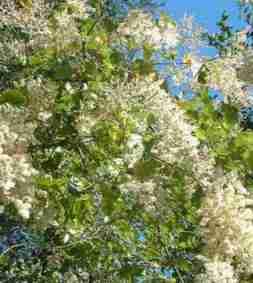
The Mixed Evergreen Forest has a lot of
dense shade. However, there are still plenty of flowers. One of my
personal favorites is Ocean Spray or
Cream Bush (Holodiscus discolor). The buds are a creamy
pink. When the flowers open they are cream and then they slowly turn a
toffee color. The plant is very soft and can be used as babies breath
in flower arrangements.
To create a Mixed Evergreen Forest in your garden you need fairly
mild temperatures. Many of the dominant species such as the Bigleaf Maple
(Acer macrophyllum), Tan-Bark
Oak (Lithocarpus densiflora), and the California
Bay (Umbellularia californica) can not withstand hard freezes.
However, you can grow these species, where temperatures often drop into
the teens, by planting them under cover of oaks or on the lower side of
structures. Remember, because cold air is denser it settles into the
lowest areas. It is coolest in canyons and in low pockets. So if you
live in a cold climate try to avoid planting our mixed evergreen forest
species in these areas. When planting these species keep in mind that
not all species in the mixed evergreen forest are evergreens. A few
species are deciduous. You want to start with some overstory plants
first such as several oaks, the California Bay, maybe a Madrone, mixed
in with and protected by Ceanothus species (if you are in the southern
part of the state and have hotter summers, start with the Ceanothus and
then after a year or so, plant the trees on the north side and in the
shade of the Ceanothus ), and as they grow and shade increases, then
you can plant the understory plants. Remember to use plenty of mulch
after planting your mixed evergreen forest. This will help to keep the
soil healthy and also to retain moisture. Water your plants well when
you first plant them as this helps to settle the soil around the roots
and rehydrate the soil. )
Also, one item that we don't think about too much is that as plants grow they can actually change the climate, just by being there. So, if you have a dry, hot, sunny, open spot and the more trees and shrubs (such as from the Mixed Evergreen Forest) that you grow, the more the climate will change and your spot will be moist, cool, shady, and closed-in!
Plants
A list of California native plants that grow in the Mixed-evergreen Forest plant community.